
The short answer
An automatic lens edger usually carries three or four wheels on one spindle: a roughing wheel for plastic lenses, often a separate roughing wheel for glass, a finishing wheel with a bevel groove and a flat zone, and a polishing wheel. A hand edger has a diamond wheel with coarse and fine zones, often with a V-groove. Wheels wear: dress the ones the manual allows, and replace the rest when the edge quality drops.
The wheels and what each one does
The set depends on the model and on which lens materials it edges, but the jobs are the same on every edger.
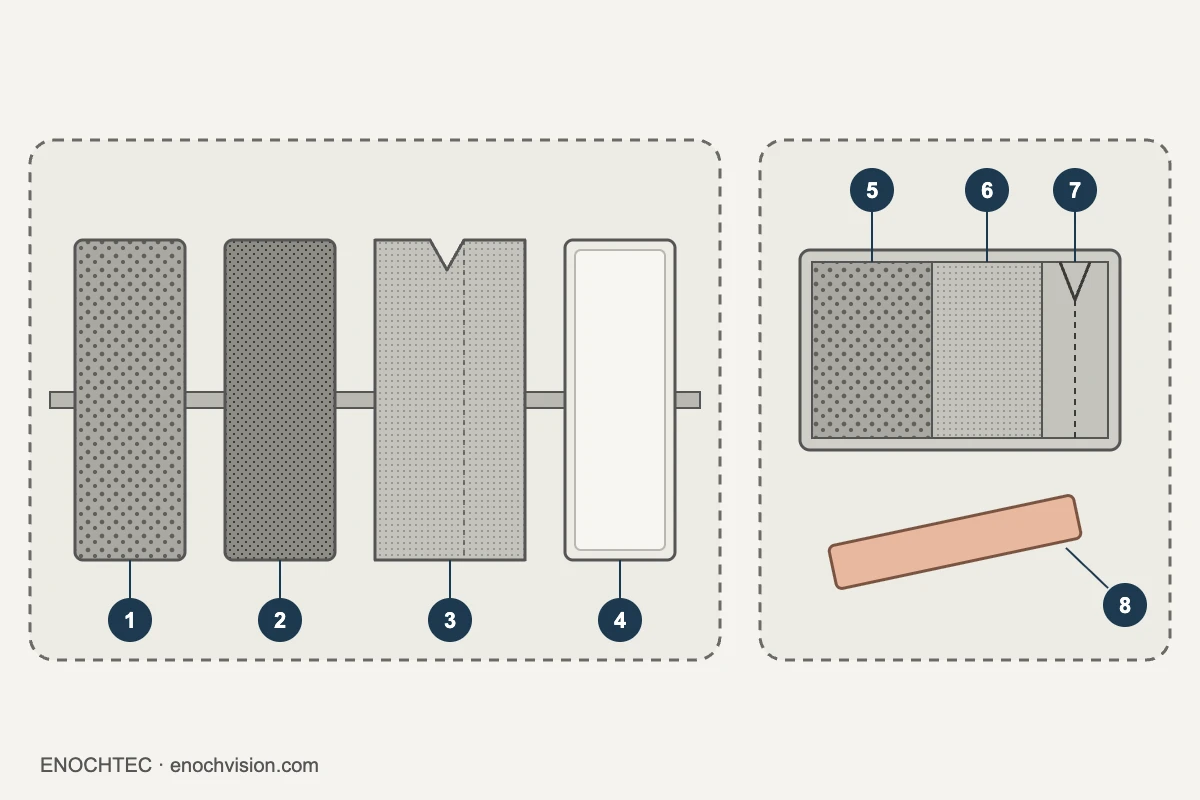
- Roughing wheel for plastic: a coarse diamond wheel that removes most of the material from resin, high-index and polycarbonate lenses.
- Glass roughing wheel: a separate wheel for mineral glass, on edgers that edge glass. Glass should never be run on the plastic roughing wheel.
- Finishing wheel: a finer wheel. Its V-groove forms the bevel for full-rim frames; its flat zone gives the flat edge for semi-rimless and rimless lenses.
- Polishing wheel: a very fine wheel that turns the matte edge glossy where it shows.
- Coarse zone of a hand edger wheel: removes material quickly, for example 180 grit.
- Fine zone: leaves a smoother edge, for example 280 grit, or 400 grit on a third wheel.
- V-groove: on some hand edger wheels, for touching up a bevel by hand.
- Dressing stick: an abrasive stone that clears a loaded bonded wheel and exposes fresh diamond.
What the grit number means
The grit number describes the size of the abrasive particles: the higher the number, the finer the particles and the smoother the edge. On a hand edger, 180 grit removes material fast, 280 grit smooths, and 400 grit gives the finest finish before polishing.
| Model | Wheels | Notes |
|---|---|---|
| CP-7A-35WV | One diamond wheel, 14 × 100 × 35 mm: 180 grit coarse, 280 grit fine with V-groove | 4,200 rpm, 100 W; resin, glass and PC |
| LY-316 | Three wheels: 180#, 280# and 400# | 3,000 rpm, 120 W; custom PC wheel available |
| SJG-1000AK, SJG-900, SJG-910A | Ø90 mm wheel set | The SJG-900 also edges glass |
| SJG-700A, ALE-1900, AE-688 | Ø100 mm wheel set | The AE-688 edges PC, resin and glass |
Match the wheel to the lens material
- Resin and high-index: edged wet on the standard plastic roughing wheel.
- Polycarbonate: soft and sticky when hot, so it loads wheels quickly. Use the polycarbonate cycle, a sharp wheel, and clean the swarf away. Some hand edger manuals say to edge polycarbonate dry and every other material wet. For hand edging PC, the LY-316 can be ordered with a custom PC wheel.
- Glass: needs its own roughing wheel. Running glass on a plastic wheel wears it out fast; clean the chamber before going back to plastic.
Plated or bonded: which wheels you can dress
Diamond wheels are made in two ways, and the difference decides how you look after them.
- Plated wheels carry a single layer of diamond on a metal body. Dressing knocks the diamonds off, so they are not dressed: they are replaced when they stop cutting.
- Bonded (sintered) wheels hold diamond throughout a metal or resin bond. A dressing stone wears the bond back and exposes fresh diamond, so they can be dressed when they glaze or load with material.
Edger makers supply dressing stones for the wheels that can be dressed, typically the glass roughing, finishing and polishing wheels. Follow the manual of your edger, and ask the supplier which wheels on your model are plated. Our CP-3-800 groover, for example, is supplied with a 180-grit dressing stone for its diamond cutter.
Signs a wheel needs dressing or replacing
| What you see | Likely meaning | What to do |
|---|---|---|
| Cycles take longer, the lens gets warm | Wheel glazed or loaded with material | Check the water, then dress if the wheel is bonded |
| Chips or flakes along the edge | Worn or loaded wheel | Dress or replace the wheel |
| Scoring marks on the finished edge | Material stuck on the roughing wheel | Clean and dress as the manual describes |
| Size drifts, uneven bevel | Worn finishing wheel | Recalibrate; replace the wheel if it keeps drifting |
| Grooves worn into the wheel face | Lenses always meet the same part of the wheel | Replace or have the wheel trued |
Keep wheels cutting longer
- Keep the water flowing and the tank, filter and drain clean.
- Always select the right lens material on the screen.
- Never run glass on the plastic wheel.
- Clean polycarbonate swarf out between lenses.
- Keep a count of jobs, so you can see when cutting slows down.
- Order blocking pads and spare wheels before you run out; see Tools & Spare Parts.
Background sources: Lens edging apparatus, US patent 4,233,784 · Increasing the service life of grinding wheels, US patent 5,961,376 · Neksia edger user manual (Essilor Instruments) · Hand edger manual, diamond wheel profiles (Centrostyle)
Questions
How many wheels does a lens edger have?
Most automatic edgers have three or four: a plastic roughing wheel, often a glass roughing wheel, a finishing wheel with a bevel groove and a flat zone, and a polishing wheel. A hand edger has one diamond wheel with coarse and fine zones, or separate wheels such as the 180#, 280# and 400# wheels of the LY-316.
What does the grit number of a wheel mean?
It describes the size of the abrasive particles. A higher number is finer: 180 grit removes material fast, 280 grit smooths the edge and 400 grit gives the finest finish.
Can I dress any edger wheel?
No. Bonded wheels can be dressed with the stone the maker supplies. Plated wheels have a single layer of diamond and are replaced instead, because dressing would strip the diamond off.
Can I edge glass on a plastic roughing wheel?
No. Glass needs its own roughing wheel. Running it on the plastic wheel wears the wheel out quickly.
How do I know when to replace an edger wheel?
When cycles get slower, edges chip or show scoring, or the size keeps drifting after recalibration, and dressing no longer helps.