
An auto lensmeter and a manual lensometer
Most shops use the automatic model day to day and keep a manual one as a backup.
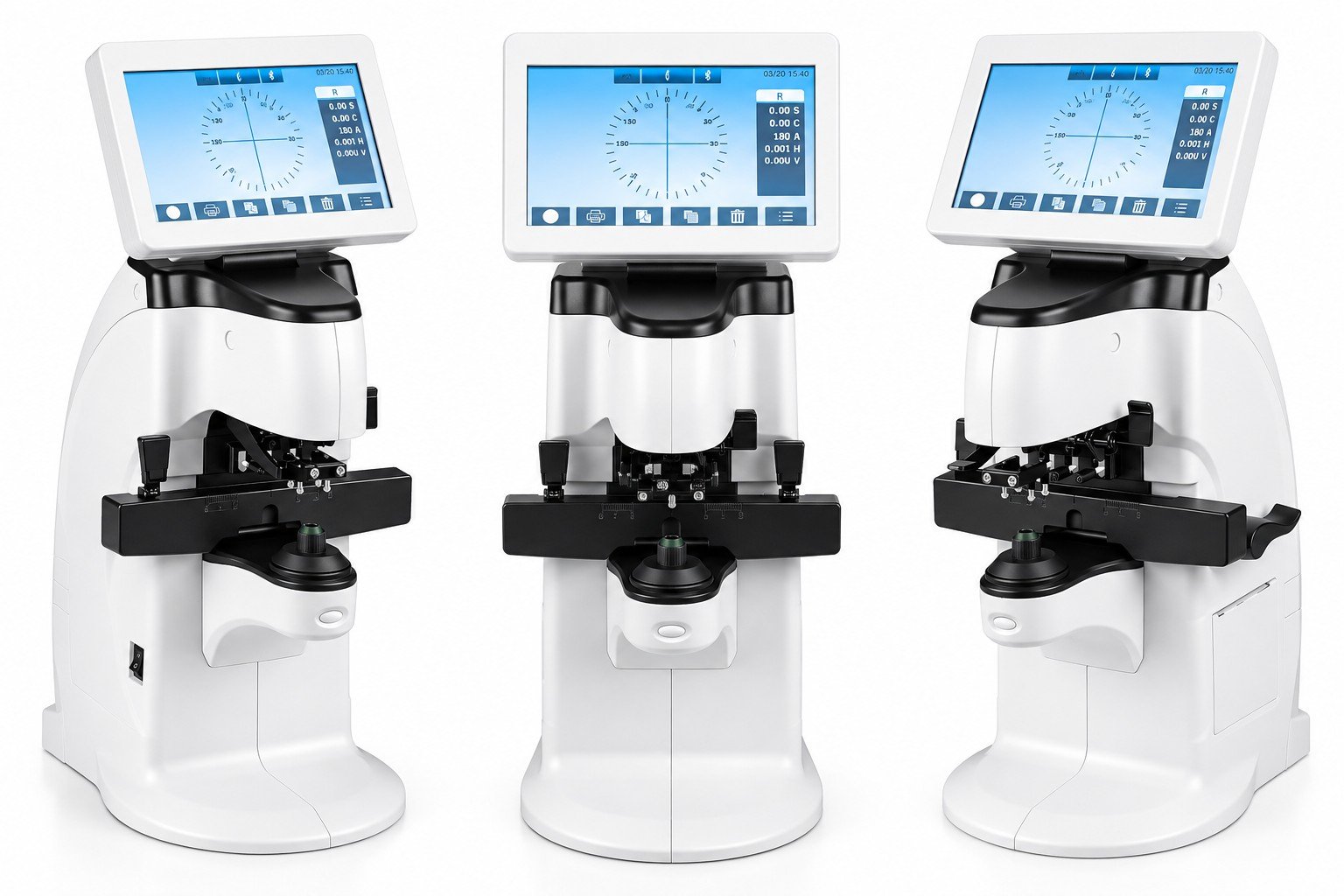
HV-600
Auto lensmeter, 7" touch screen, UV and blue-light test.- Sphere
- 0 to ±25.00 D
- Screen
- 7" touch
- Transmittance
- UV 400 nm, blue 425 nm
- Weight
- 3.7 kg
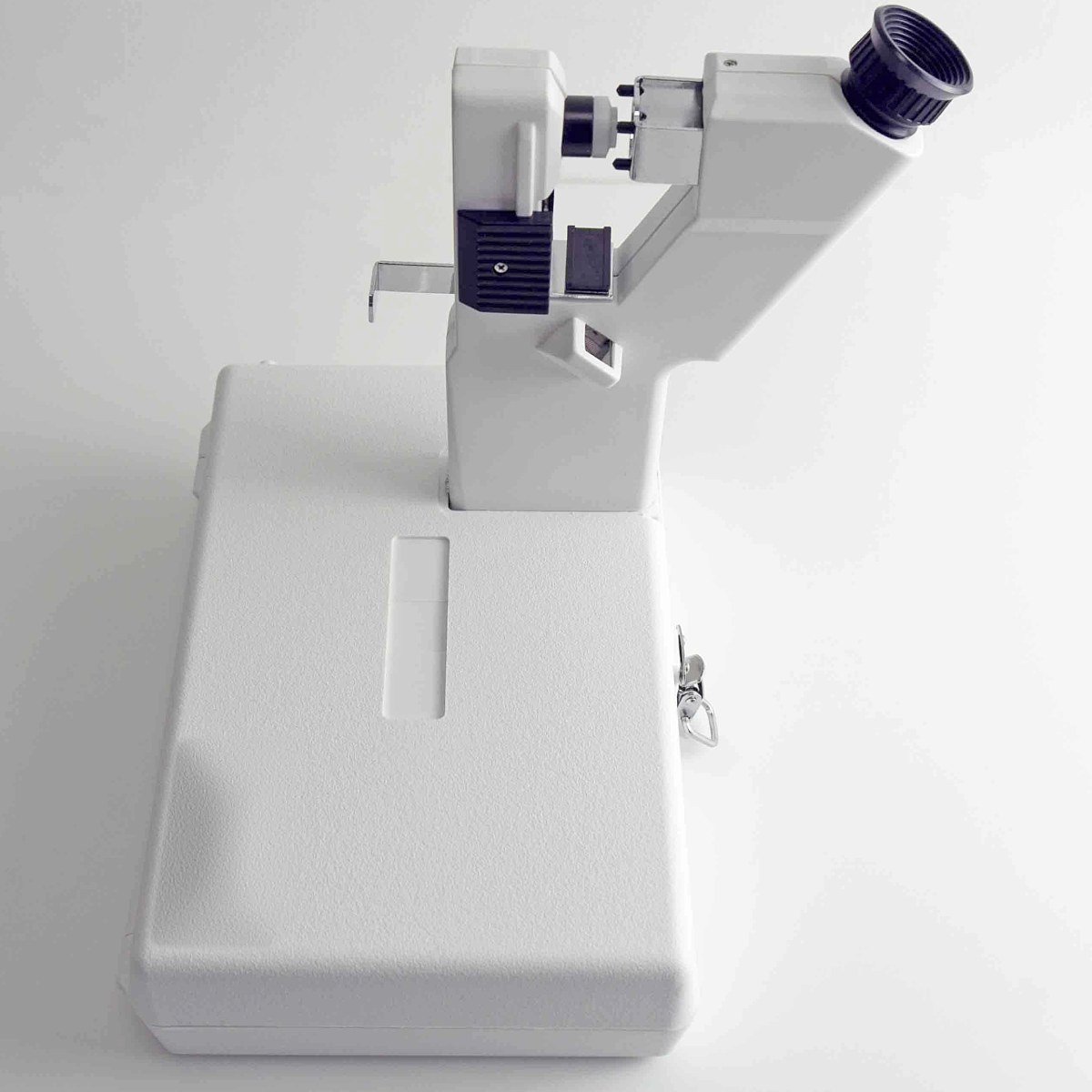
CP-1B
Portable manual lensometer, 0 to ±25 D, prism to 20 Δ.- Range
- 0 to ±25 D
- Graduation
- 0.125 D to ±5 D
- Prism
- to 20 Δ with compensator
- Weight
- 4 kg
HV-600 and CP-1B compared
Blank cells: confirmed on your quotation.
| Specification | HV-600 (automatic) | CP-1B (manual) |
|---|---|---|
| Reading | Automatic, on screen | Manual, through the eyepiece |
| Sphere | 0 to ±25.00 D | 0 to ±25 D |
| Cylinder | 0 to ±10.00 D | Within the ±25 D range |
| Steps | 0.01 / 0.12 / 0.25 D | 0.125 D (to ±5 D), 0.25 D (±5 to ±25 D) |
| Axis | 0–180°, 1° steps | 0–180°, 1° steps |
| Add | 0–10.00 D | Read by difference (bifocal segment) |
| Prism | 0–10 Δ, x-y or polar | 0–5 Δ; 0–20 Δ with compensation device; base 0–180° |
| Lens diameter | 18–100 mm | Ø16–86 mm |
| Extras | UV and blue-light transmittance, PD and pupil height, lens topography, printer, RS232, Bluetooth | |
| Power | 110–240 V, 50–60 Hz | AC 220 V or 110 V, 3 W lamp |
| Dimensions | 235 × 192 × 436 mm | 275 × 120 × 430 mm |
| Weight | 3.7 kg | 4 kg |
What a lensmeter measures
Three checks on every job
A lensmeter reads the back vertex power of a spectacle lens (sphere, cylinder and axis), the add and any prism, and marks the optical center. In a shop it is used to verify incoming lenses, to mark the optical center before blocking, and to check the finished glasses against the prescription.
Manual or automatic
A manual lensometer shows a target through an eyepiece; the operator focuses it and reads the power wheel. An automatic lensmeter passes light through the lens onto a sensor and calculates the power, so the reading does not depend on the operator. Automatic models are faster and add extras such as transmittance and PD; manual models need skill but no electronics.
Before you buy
- Measuring ranges against your prescriptions.
- Display steps and prism notation.
- Printing and data output, if you keep records.
- Whether you will use transmittance, PD and topography.
- A backup plan: many shops keep a manual unit.
Guides
Background sources: Lensometry (StatPearls, NCBI Bookshelf) · Lensometry handout (University of Utah, Moran CORE) · ANSI Z80.1 quick reference (The Vision Council)
Lensmeter questions
Lensmeter, lensometer or focimeter: what is the difference?
None. They are three names for the same instrument; “focimeter” is common in ISO standards and Europe, “lensometer” and “lensmeter” in North America and Asia.
Manual or automatic?
Both measure the same parameters. Automatic reduces operator variation and adds extras; manual needs a trained eye but no electronics. See our comparison guide.
Can a lensmeter check UV protection?
The HV-600 measures UV transmittance at 400 nm and blue-light transmittance at 425 nm. The manual CP-1B does not.
Can it read progressive lenses?
Yes. Read the distance power at the distance circle and use the engraved marks for the add.