
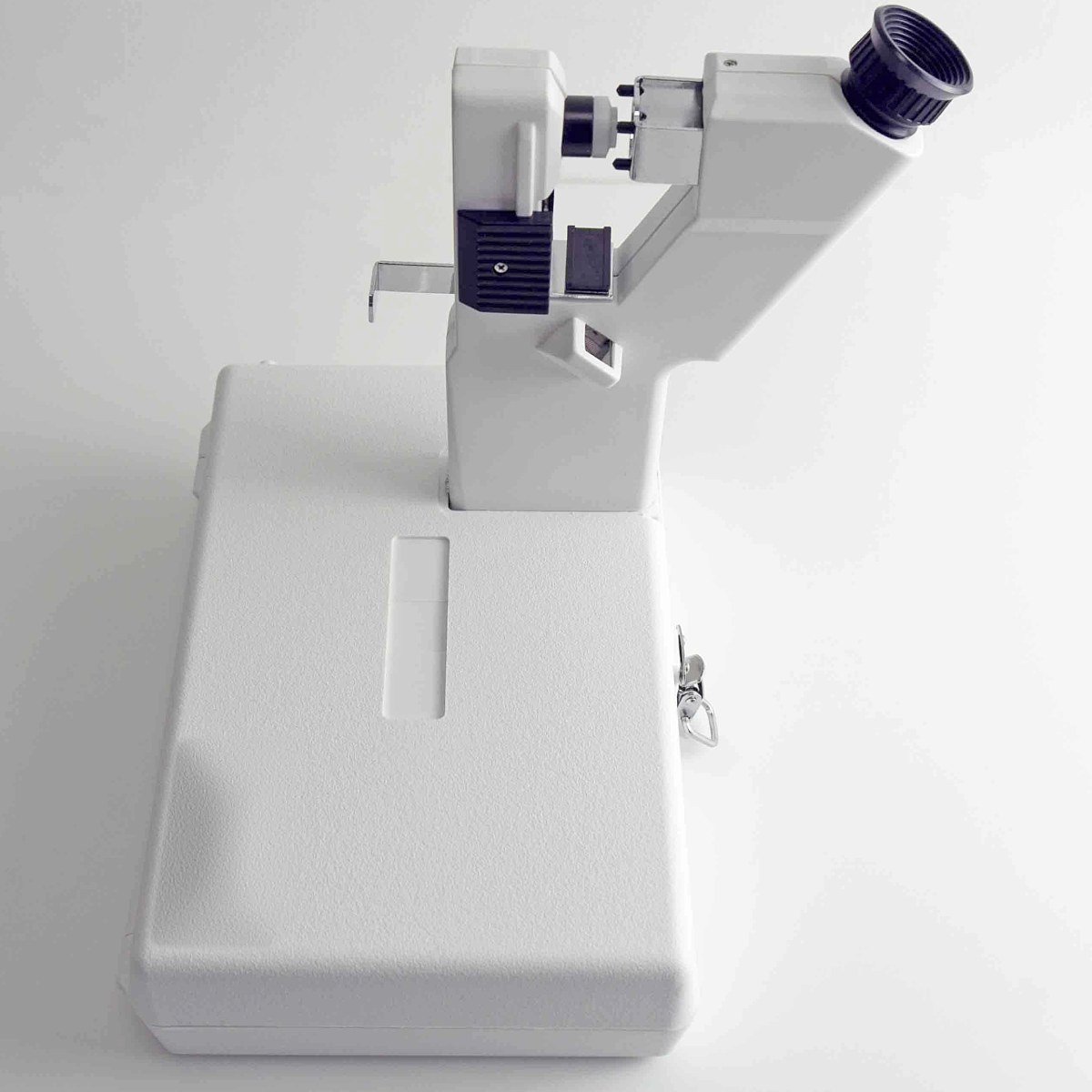
CP-1B Portable manual lensometer (lensmeter)
A portable manual lensometer with eyepiece reading. It measures sphere, cylinder, axis and prism from 0 to ±25 D on lenses from Ø16 to Ø86 mm, and reads prism up to 20 prism diopters with its prism compensation device. No software and no screen: a dependable first lensmeter for a small shop, or a backup to an auto lensmeter.
Delivery, packing and documents
What the CP-1B does
Sphere and cylinder to ±25 D
Reads lens power from 0 to ±25 D. The outer reading is graduated in 0.125 D; the inner reading in 0.125 D up to ±5 D and 0.25 D from ±5 D to ±25 D.
Cylinder axis
Axis from 0 to 180° in 1° steps.
Prism to 20 Δ
Prism from 0 to 5 prism diopters directly, and 0 to 20 prism diopters in 1 Δ graduations with the prism compensation device. Prism base angle 0–180°.
Eyepiece adjustment
The eyepiece adjusts over ±5 D, so each operator can focus the reticle to their own eye.
Lenses Ø16–86 mm
Takes lenses from 16 to 86 mm in diameter, from small rimless lenses to uncut blanks.
Portable, no software
A self-contained optical instrument with a 3 W lamp. Nothing to update and nothing to crash; it works as long as the lamp does.
A closer look at the CP-1B
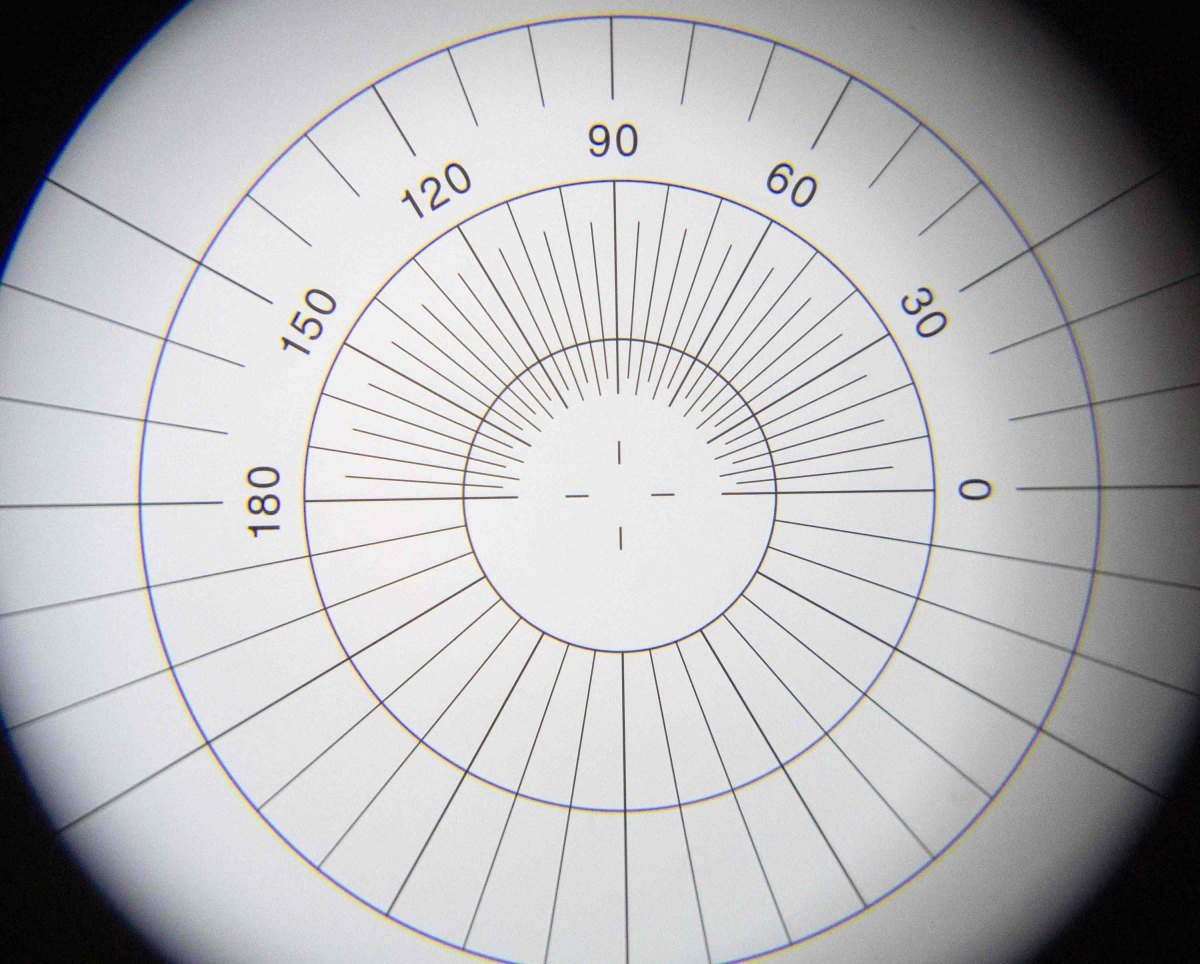
Axis reticle
The reticle seen through the eyepiece carries a 0–180° axis scale, so the cylinder axis is read in the same view as the target.
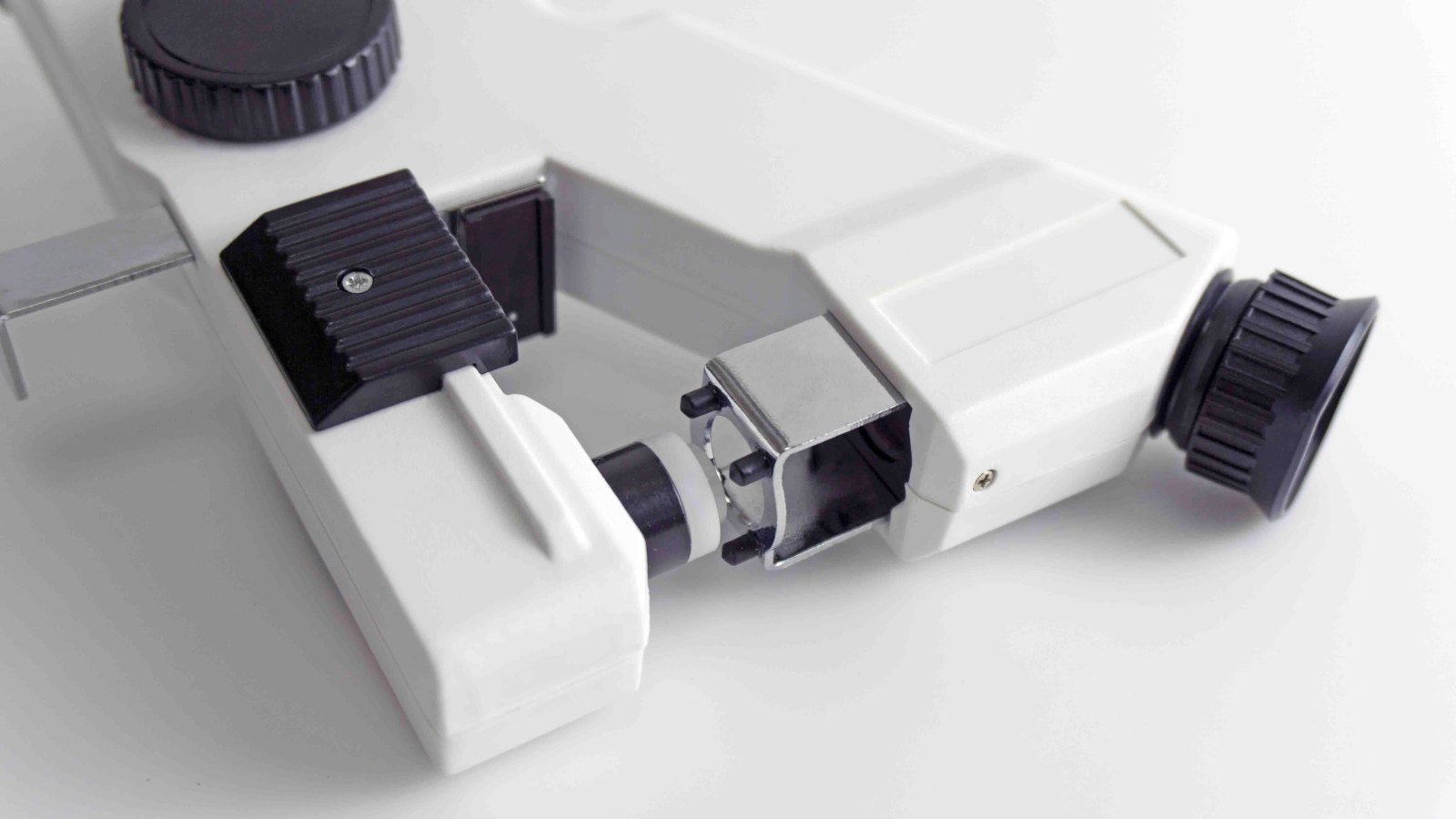
Lens stop and eyepiece
The lens rests against the lens stop, held by the lens holder. The eyepiece focuses over ±5 D to suit each operator’s eye.
CP-1B in figures
Published specifications. Anything not listed here is confirmed in writing on your quotation, never estimated.
The prism compensation device extends the prism range from 5 Δ to 20 Δ.
Measurement
- Measuring range
- 0 to ±25 D
- Outer reading
- 0.125 D
- Inner reading
- 0.125 D (0 to ±5 D); 0.25 D (±5 to ±25 D)
- Cylinder axis
- 0–180°, 1° steps
- Prism power
- 0–5 Δ
- Prism with compensation device
- 0–20 Δ, 1 Δ graduations
- Prism base angle
- 0–180°
- Eyepiece adjustment
- ±5 D
- Lens diameter
- Ø16–86 mm
Unit
- Lamp
- 3 V, 3 W
- Power supply
- AC 220 V or AC 110 V
- Dimensions
- 275 × 120 × 430 mm
- Weight
- 4 kg
How to read a manual lensometer
How it works
A manual lensometer shows an illuminated target (the mires) through a telescope. You turn the power wheel until the target is sharp through the lens and read the power off the scale; an axis wheel rotates the target to find the cylinder axis, and rings in the reticle measure prism. A marker inks the optical center.
The common target is a single line for sphere crossed by a set of three lines for cylinder. With the minus-cylinder method, you focus the single line first and record that power as the sphere, then turn toward plus until the three lines focus; the difference is the cylinder, and the axis wheel gives the axis.
Results depend on the operator, which is why the first step, focusing the eyepiece, matters so much. Always approach the reading in one direction rather than rocking the wheel back and forth.
Check before you order
- Measuring range against your prescriptions: 0 to ±25 D on the CP-1B.
- Graduation fine enough for your tolerance checks: 0.125 D up to ±5 D, 0.25 D beyond.
- Prism: 5 Δ directly, 20 Δ with the compensation device, if you fit prism prescriptions.
- Lens sizes you handle: Ø16–86 mm.
- Supply voltage for the lamp (220 V or 110 V).
Good practice
- Focus the eyepiece: set the power to zero, turn the eyepiece fully counter-clockwise, then slowly clockwise until the reticle is just sharp.
- Place the glasses back surface against the lens stop, temples away from you, both lenses flat on the table. Center the mires.
- Focus the single line, straighten it with the axis wheel, and record the sphere.
- Turn toward plus until the three lines focus. The difference is the cylinder; read the axis and record it as three digits (090, not 90).
- For a bifocal, center the segment, refocus and subtract the distance reading to get the add.
- Read prism at the marked pupil position: the mires move toward the base. Beyond 5 Δ, use the prism compensation device. Mark the optical center.
Care and maintenance
- Check the zero before each session; if it is off, correct your readings by that amount.
- Keep the lens stop, lens holder and eyepiece clean.
- Common errors to watch: dirty lenses, a tilted frame (false cylinder), and missing low cylinders around 0.25 D.
Background sources: Lensometry handout (University of Utah, Moran CORE) · Lensometry (StatPearls, NCBI Bookshelf) · Plus-cylinder manual lensometry (University of Iowa)
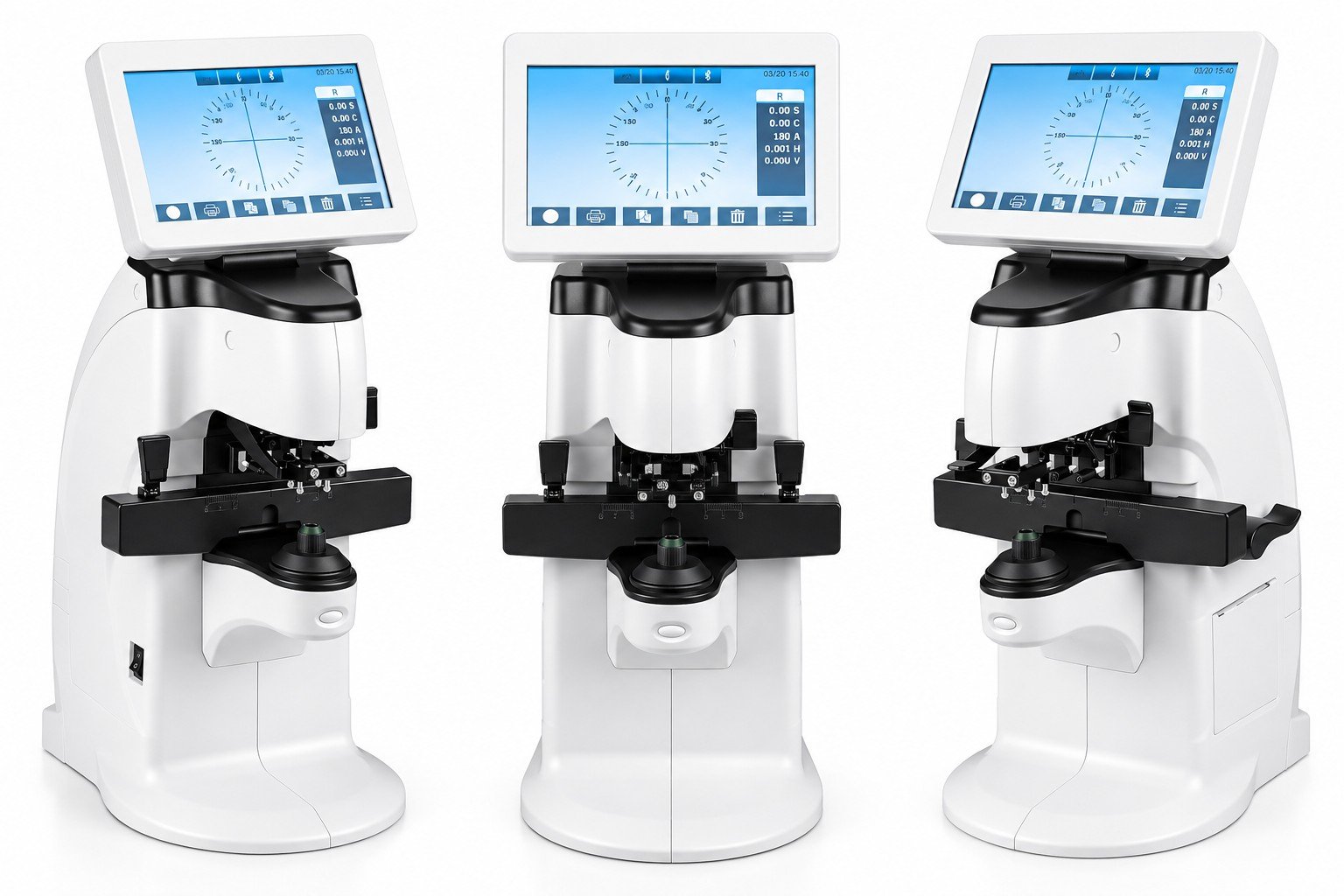
Often ordered with the CP-1B
CP-1B questions
Manual or automatic lensmeter?
Both measure the same parameters. The CP-1B needs a trained operator but no electronics beyond its lamp; the HV-600 automatic model reads faster and adds transmittance, PD and printing.
What does the prism compensation device do?
The reticle reads prism up to 5 prism diopters. With the compensation device the CP-1B measures up to 20 prism diopters, in 1 Δ graduations.
Can a manual lensometer read progressive lenses?
Yes, with care: read the distance power at the distance circle at the top of the lens, and use the engraved marks for the add.
How do I read prism?
Measure at the marked pupil position. On the reticle the first ring is usually 0.5 prism diopter and each further ring 1 prism diopter; the mires move toward the base.
How often should it be checked?
Check the zero at the start of each session. If the mires do not focus at 0.00, note the error and correct your readings.