
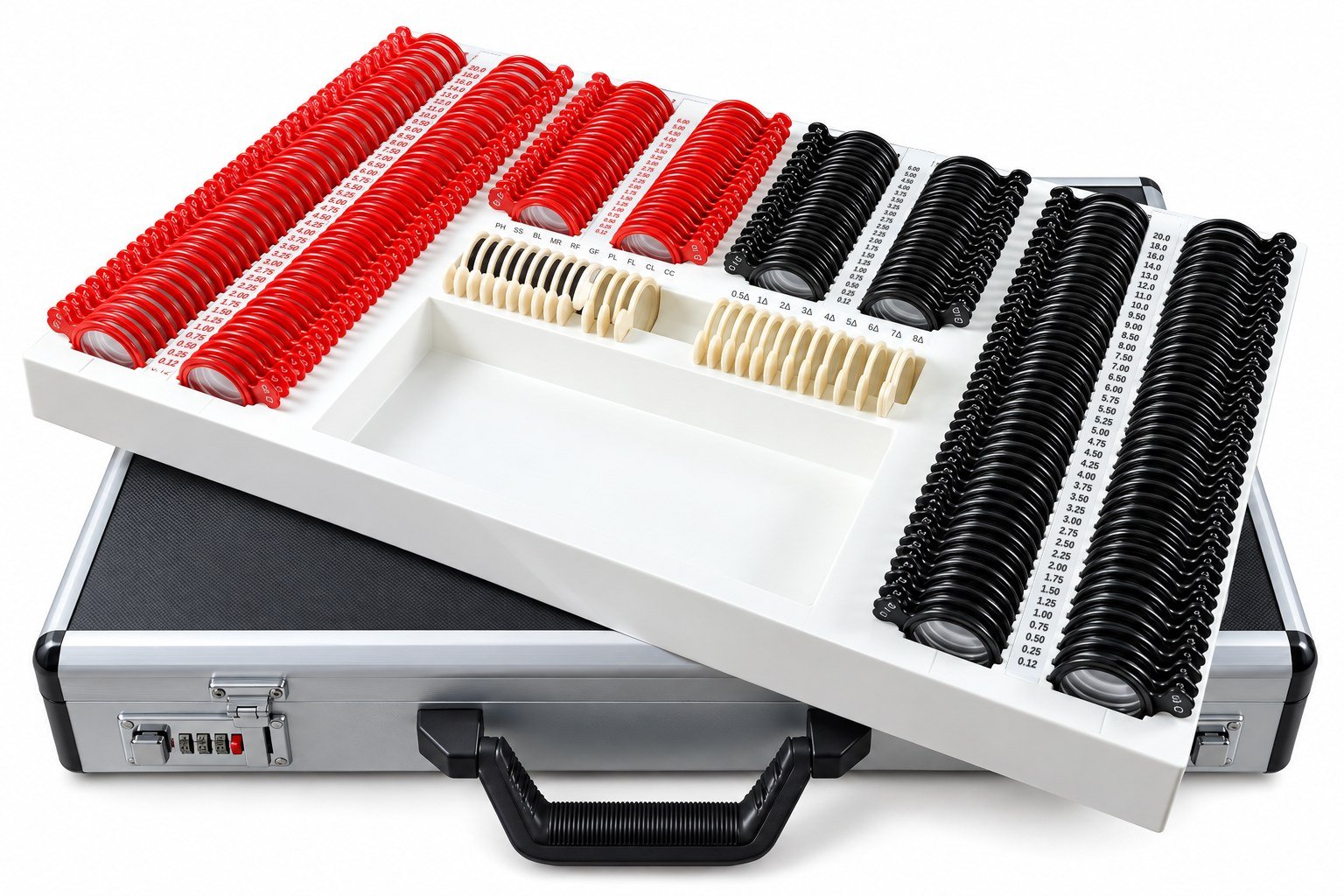
TLC-232P Trial lens box, 266 plastic-rim lenses
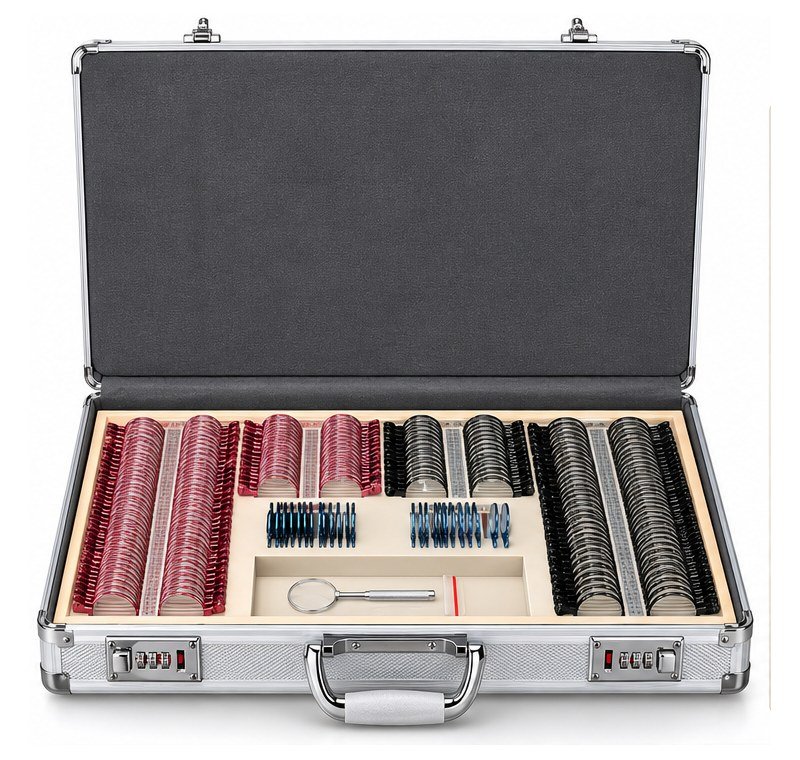
A 266-lens trial lens box with color-coded plastic rims: red for minus, black for plus, cream for prisms and auxiliary lenses. Clear aperture Ø30 mm in Ø38 mm rims, on a resin tray in an aluminum case. Two configurations: 266A with spheres to ±20.00 D in the classic steps, or 266B with 0.25 D steps in the high minus range.
Delivery, packing and documents
What is in the TLC-232P
Two configurations
266A: plus and minus spheres to 20.00 D, two of each. 266B: minus spheres in 0.25 D steps to 9.00 D (with −0.37 D) and on to −20.00 D; plus spheres to +12.00 D.
Cylinders to ±6 D
Plus and minus cylinders, two of each: 0.12 D, then 0.25 D steps to 4.00 D, and 4.50, 5.00 and 6.00 D.
Prisms 0.5 to 8 Δ
Two each of 0.5, 1 and 2 Δ, and one each of 3 to 8 Δ.
14 auxiliary lenses
Red and green filters, two occluders, a plano lens, two Maddox rods, a frosted lens, a cross-line lens, two pinholes, two stenopaeic slits and a cross cylinder.
Color-coded plastic rims
Red, black and cream rims with the power on each tab, so the right lens comes out first time.
Resin tray, aluminum case
A labeled resin tray in an aluminum case with combination locks.
A closer look at the TLC-232P
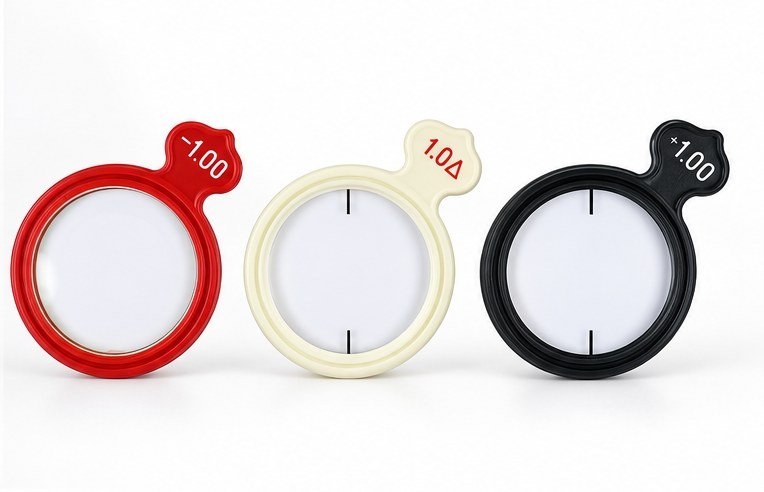
Three rim colors
Red rims for minus lenses, black for plus and cream for prisms and auxiliary lenses, with the power on each tab.
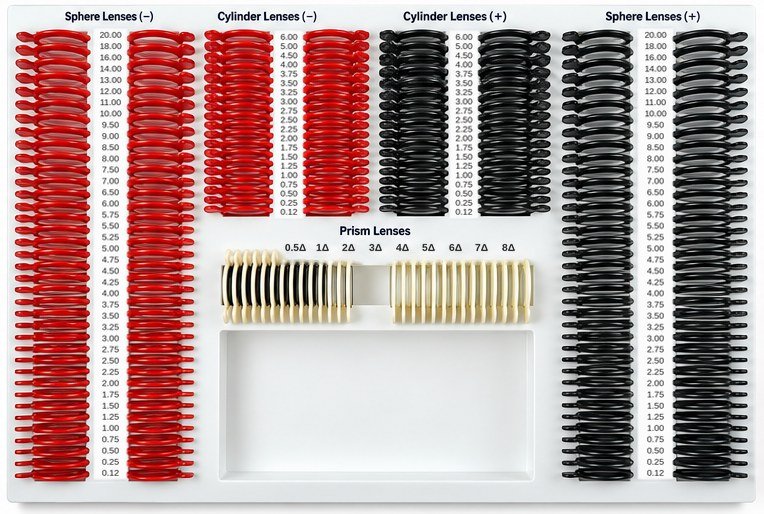
Tray layout
Minus spheres and cylinders on the left, plus on the right, prisms and auxiliary lenses in the center, each row labeled with its power.
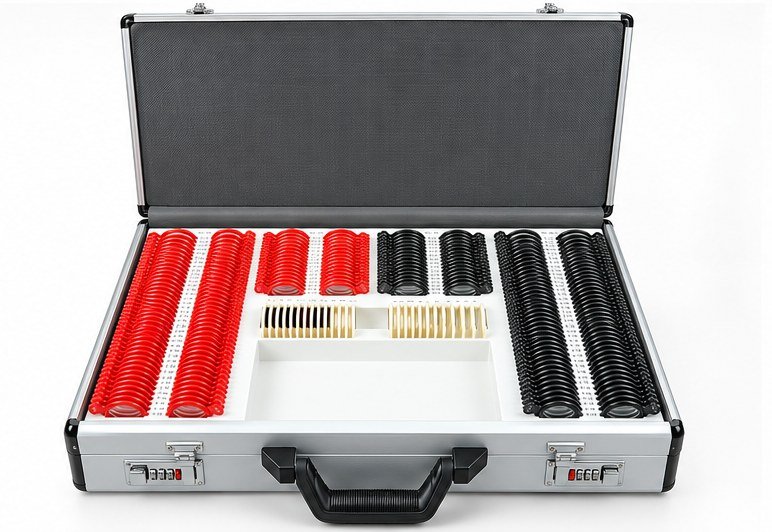
Aluminum case
The resin tray fits an aluminum case with combination locks and a carry handle.
TLC-232P in figures
Published specifications. Anything not listed here is confirmed in writing on your quotation, never estimated.
266B puts 0.25 D steps in the high minus range and drops plus spheres above +12.00 D. Case dimensions and weight are confirmed in writing on your quotation.
TLC-232P
- Configurations
- 266A or 266B, 266 lenses each
- Lens size
- Ø38 mm outer, Ø30 mm clear aperture
- Rims
- Plastic, color-coded (red minus, black plus, cream prisms and auxiliary)
- Tray
- Resin
- Case
- Aluminum
- Sphere range
- ±0.12 to ±20.00 D (266B: +0.12 to +12.00 D, −0.12 to −20.00 D)
- Cylinder range
- ±0.12 to ±6.00 D
- Prisms
- 0.5 to 8 Δ
266A lens powers
- Spheres, plus and minus
- 0.12; 0.25 to 6.00 D in 0.25 D steps; 6.50 to 10.00 D in 0.50 D steps; 11, 12, 13, 14, 16, 18, 20 D (two of each)
- Cylinders, plus and minus
- 0.12; 0.25 to 4.00 D in 0.25 D steps; 4.50, 5.00, 6.00 D (two of each)
- Prisms
- 0.5, 1 and 2 Δ (two of each); 3, 4, 5, 6, 7 and 8 Δ (one of each)
266B lens powers
- Minus spheres
- 0.12, 0.25, 0.37; 0.50 to 9.00 D in 0.25 D steps; 9.50, 10, 11, 12, 13, 14, 15, 16, 18, 20 D (two of each)
- Plus spheres
- 0.12; 0.25 to 5.50 D in 0.25 D steps; 6.00 to 8.00 D in 0.50 D steps; 9, 10, 11, 12 D (two of each)
- Cylinders, plus and minus
- 0.12; 0.25 to 4.00 D in 0.25 D steps; 4.50, 5.00, 6.00 D (two of each)
- Prisms
- 0.5, 1 and 2 Δ (two of each); 3, 4, 5, 6, 7 and 8 Δ (one of each)
Auxiliary lenses (both)
- Red filter (RF)
- 1
- Green filter (GF)
- 1
- Occluder (BL)
- 2
- Plano lens (PL)
- 1
- Maddox rod (MR)
- 2
- Frosted lens (FL)
- 1
- Cross-line lens (CL)
- 1
- Pinhole (PH 1.5)
- 2
- Stenopaeic slit (SS 1.5)
- 2
- Cross cylinder
- 1
Choosing and using a trial lens set
How it works
A trial lens set is the lens library for subjective refraction. Lenses go into a trial frame to refine a prescription, to try it out before glasses are made, or to over-refract an existing pair. ISO 9801 covers both full-aperture and reduced-aperture trial case lenses.
A reduced aperture, Ø30 mm here, keeps lenses light, and a trial frame with a smaller aperture is lighter on the patient. It still needs to fit the trial frame: the rims are Ø38 mm across.
Choose 266B if you see many high myopes: it has 0.25 D steps in the minus range up to 9.00 D. Put the strongest sphere in the back cell, closest to the eye, and record the vertex distance for powers of ±5.00 D and above.
Check before you order
- Configuration: 266A or 266B, against the prescriptions you see.
- Aperture: Ø30 mm here; the rims are Ø38 mm and must fit your trial frame.
- Rim colors your staff will read quickly.
- Case and tray for how the set is used and stored.
Good practice
- Return every lens to its own slot straight away.
- Place the strongest sphere in the back cell of the trial frame, nearest the eye.
- Record the vertex distance for prescriptions of ±5.00 D and above.
- Check any lens you are unsure of on a lensmeter.
Care and maintenance
- Handle lenses by the rim tab, and clean them with a soft lens cloth.
- Keep the case closed and dry.
- Check powers on a lensmeter from time to time.
Background sources: ISO 9801:2009, Ophthalmic instruments: trial case lenses (ISO) · Trial frame refraction: more than just “1 or 2?” (Cybersight, Orbis) · Essential course in dispensing, part 14 (Optician)
Often ordered with the TLC-232P
TLC-232P questions
What is the difference between 266A and 266B?
266A has plus and minus spheres to 20.00 D in the classic steps. 266B has 0.25 D steps in the minus range to 9.00 D, adds −0.37 and −15.00 D, and stops the plus spheres at +12.00 D.
Why a Ø30 mm aperture?
A smaller aperture keeps the lenses light. If you want the widest field of view, choose a Ø36 mm set such as the TLC-266M2.
Will the lenses fit my trial frame?
The rims are Ø38 mm across. Check that your trial frame takes 38 mm trial lenses, or send us its model.
Why is it called 232P if it has 266 lenses?
TLC-232P is our model name for this plastic-rim set; both configurations have 266 lenses.