
RS-S44 Adjustable retinoscopy racks
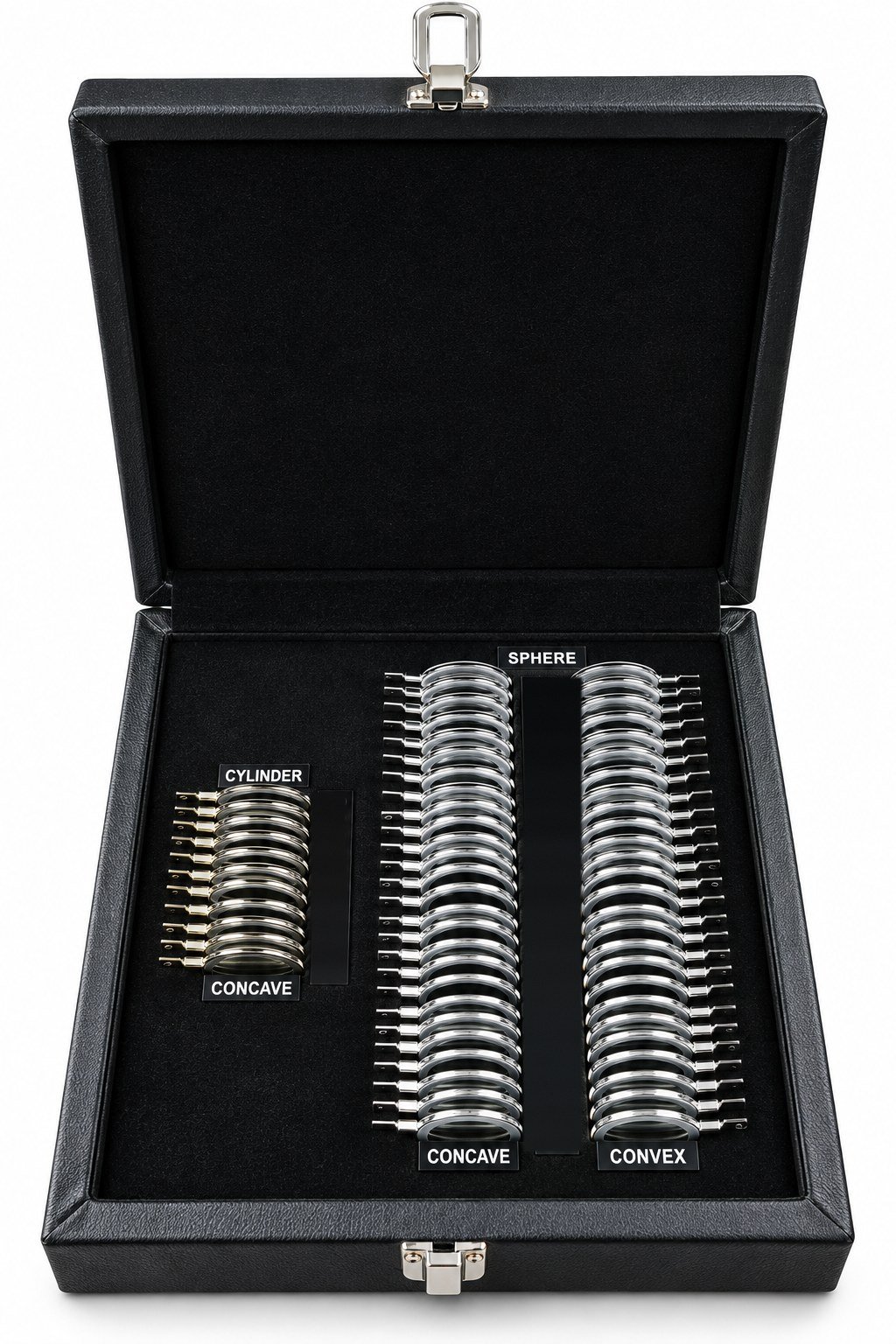
Two binocular racks with adjustable PD, a red one for minus lenses and a black one for plus lenses. Each column holds 11 powers from ±0.25 to ±5.00 D, 44 lenses in all, so you neutralise the reflex quickly. The racks are also used for accommodation tests.
Delivery, packing and documents
What the RS-S44 does
Fast neutralisation
A rack slides a row of lenses in front of the eye one after another, so you neutralise the reflex without changing trial lenses by hand.
Binocular racks
The RS-S44 holds two columns of lenses, one per eye, on a bar with adjustable PD from 40 to 74 mm, for monocular and binocular tests.
Colour-coded racks
Red racks hold minus (concave) lenses and black racks hold plus (convex) lenses. Powers are laser-etched, so they stay readable.
Accommodation tests
The RS-S44 is also used for accommodation response, relative accommodation and presbyopia tests, and for accommodation training.
A closer look at the RS-S44
RS-S44 racks
Two binocular racks, ±0.25 to ±5.00 D, PD 40–74 mm.
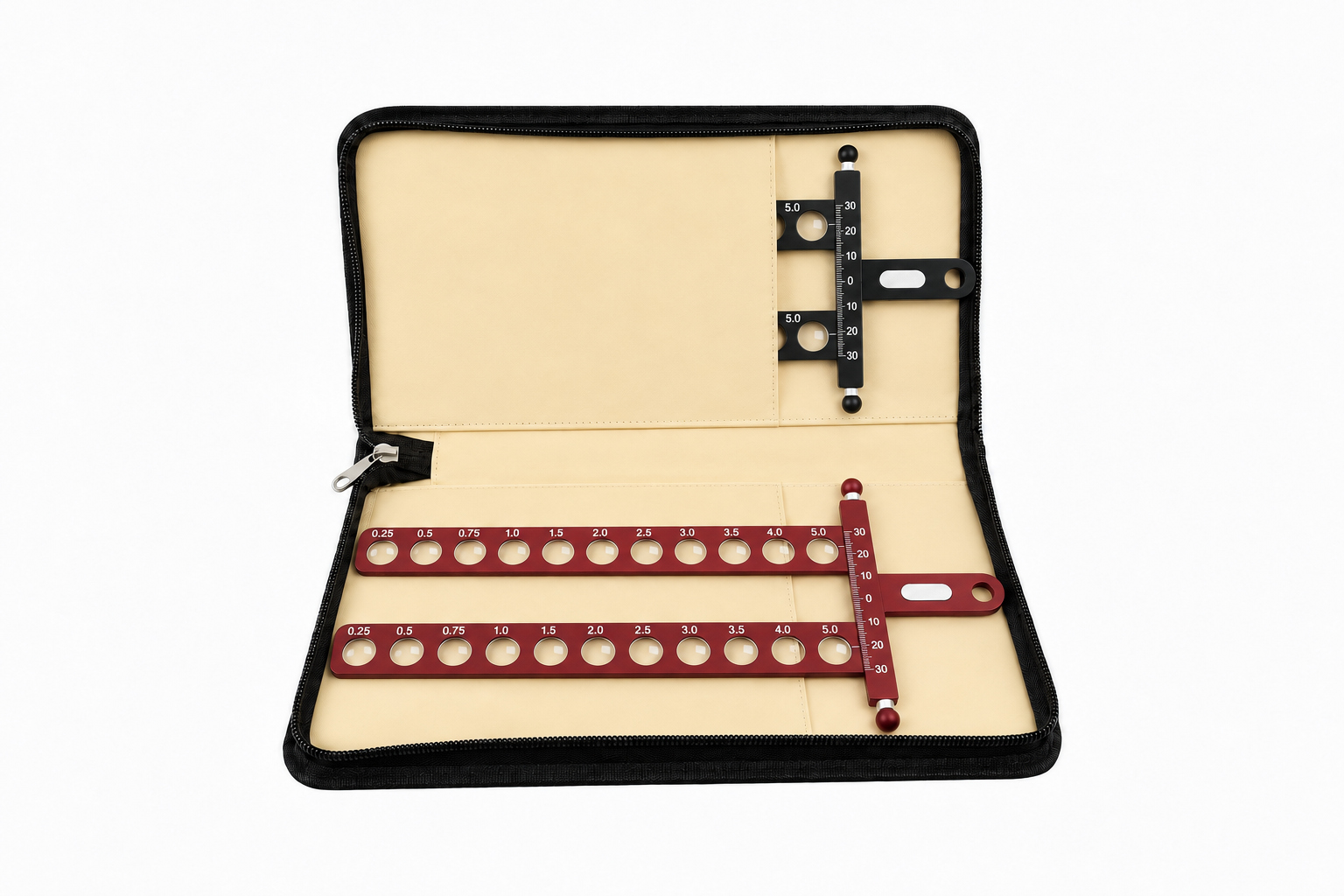
RS-S44 case
Both racks in a zip case.
RS-S44 in figures
Published specifications. Anything not listed here is confirmed in writing on your quotation, never estimated.
RS-S44 retinoscopy racks
- Powers
- ±0.25, 0.50, 0.75, 1.00, 1.50, 2.00, 2.50, 3.00, 3.50, 4.00, 5.00 D
- Lens count
- 44, 11 powers per column
- Colour code
- Red minus, black plus
- PD
- Adjustable 40–74 mm, monocular and binocular
- Lens
- Ø17 mm; aperture Ø11 mm
- Size
- 320 × 145 mm
- Weight
- 189 g
- Markings
- Laser-etched powers
- Case
- Zip case
Retinoscopy with racks
Racks or loose lenses
A rack slides a row of lenses in front of the eye one after another, so you neutralise the reflex without changing trial lenses by hand. That keeps the test short, which matters most with children.
Why retinoscopy
Retinoscopy measures the refractive error from the light reflex in the pupil, so it works with young children and with patients who cannot give reliable answers. It is also a quick objective starting point before subjective refraction.
Check before you order
- Power range: the RS-S44 covers low powers, up to ±5.00 D. For high plus and minus, see the RS-2R32.
- You need a retinoscope as well, such as the SR-24A.
Good practice
- Keep a fixed working distance and allow for it: 1.50 D at 67 cm, 2.00 D at 50 cm.
- Have the patient fixate a distant target with both eyes open.
- Sweep the streak along each principal meridian and watch for with or against movement.
- Move along the rack until the reflex is neutral, then subtract the working distance.
Often ordered with the RS-S44
RS-S44 questions
What is a retinoscopy rack used for?
A retinoscopy rack holds a row of trial lenses on a handle or bar. You slide it in front of the eye to neutralise the reflex quickly, without changing loose lenses. Racks are common for children and for fast checks.
Which powers are on the RS-S44?
Each column has 11 powers: 0.25, 0.50, 0.75, 1.00, 1.50, 2.00, 2.50, 3.00, 3.50, 4.00 and 5.00 D, in black plus and red minus, 44 lenses in all.
What do the red and black racks mean?
Red racks hold minus (concave) lenses and black racks hold plus (convex) lenses, on both the RS-S44 and the RS-2R32.
Do I need a retinoscope as well?
Yes. The racks supply the lenses; a streak retinoscope such as the SR-24A gives the reflex you neutralise.
Do the racks replace a trial lens set?
No. Racks speed up retinoscopy; the final prescription is still refined with a trial lens set and trial frame or a phoropter.