
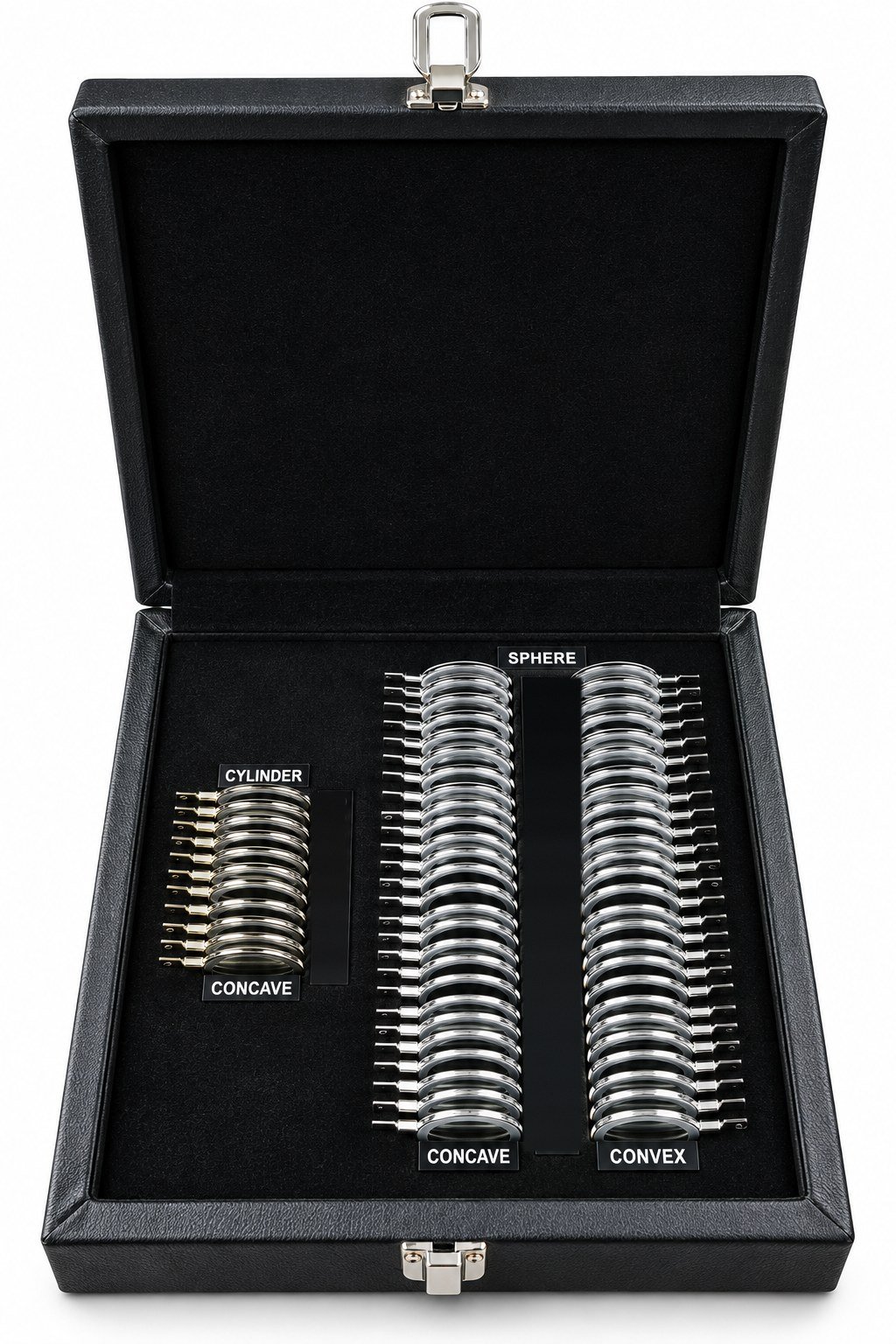
JP-68 Small trial lens set, 68 lenses
A compact 68-lens trial lens set in a leather case with a wooden tray. The lenses are Ø38 mm across, with metal or plastic rims and a clear aperture of Ø36 mm or Ø26 mm. The tray holds concave and convex spheres and concave cylinders.
Delivery, packing and documents
What the JP-68 offers
68 lenses
Concave and convex spheres and concave cylinders in one compact tray.
Metal or plastic rims
Choose metal rims, or lighter plastic rims.
Full or reduced aperture
A clear aperture of Ø36 mm, or Ø26 mm for a thinner, lighter lens; both Ø38 mm across.
Wooden tray, leather case
A labeled wooden tray in a leather case with a clasp.
A closer look at the JP-68
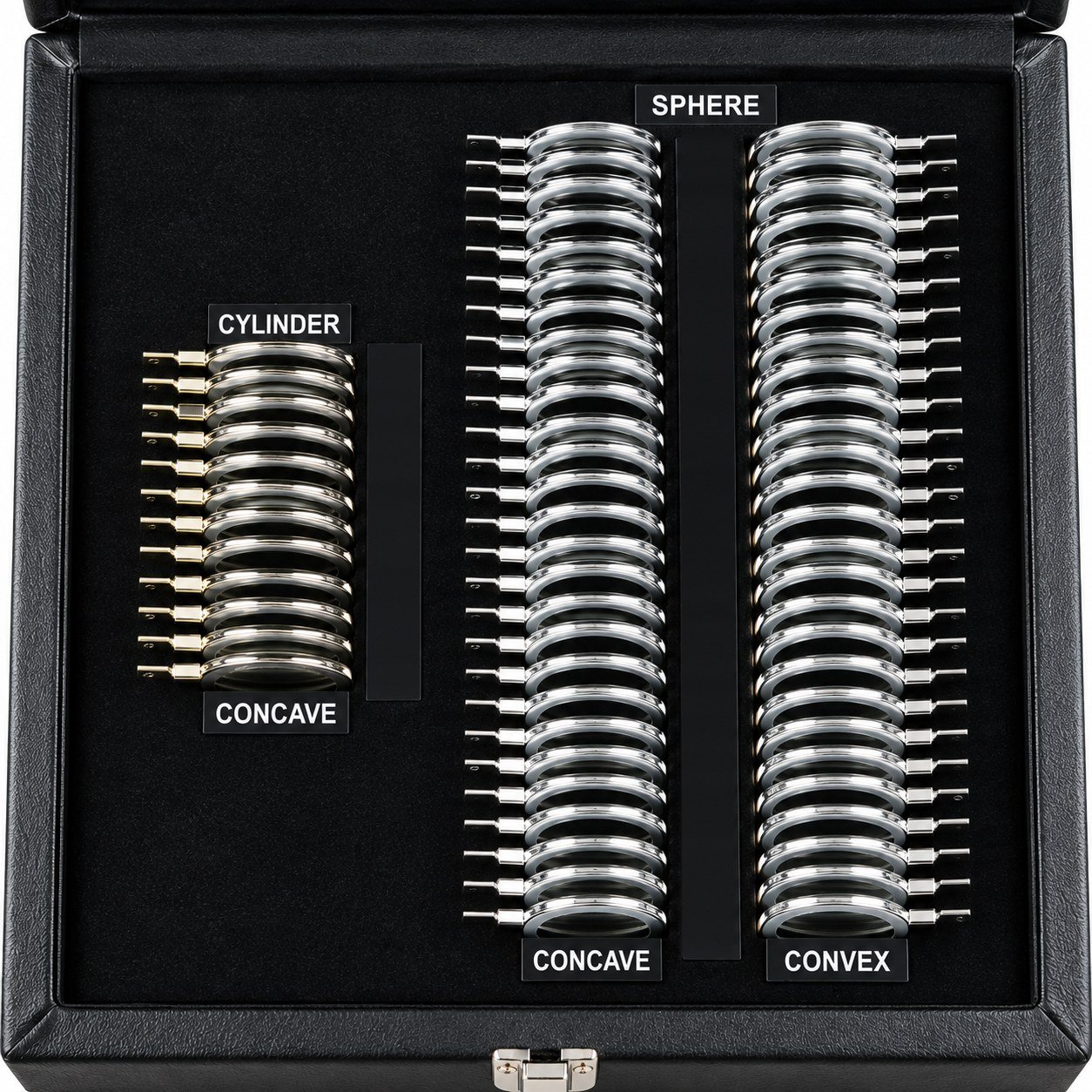
Compact tray
Concave cylinders on the left, concave and convex spheres side by side, each group labeled on the tray.
JP-68 in figures
Published specifications. Anything not listed here is confirmed in writing on your quotation, never estimated.
The power of each lens, and the case dimensions and weight, are confirmed in writing on your quotation.
JP-68
- Configuration
- 68 lenses
- Lens size
- Ø38 mm outer; Ø36 mm or Ø26 mm clear aperture
- Rims
- Metal or plastic
- Lens groups
- Concave spheres, convex spheres, concave cylinders
- Tray
- Wood
- Case
- Leather
When a 68-lens set is enough
How it works
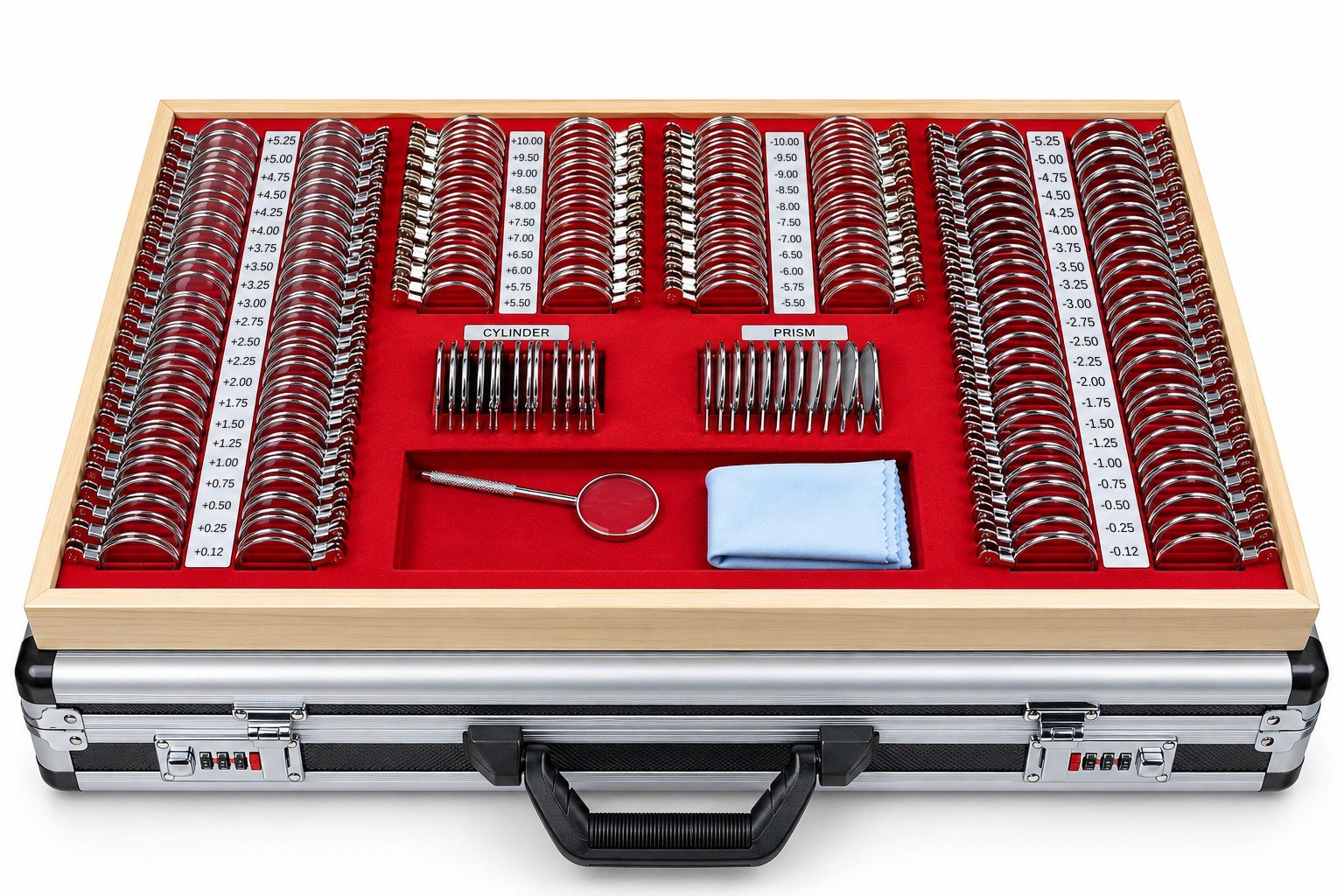
A full set, such as our 266-lens sets, covers almost any prescription and test. A 68-lens set covers the everyday spheres and cylinders in a case that fits on a counter or in a bag, which suits a small shop, a second room, or screening away from the shop.
ISO 9801 covers both full-aperture and reduced-aperture trial case lenses. A reduced aperture, such as the Ø26 mm option here, keeps high-power lenses thinner and lighter, but gives a smaller field of view.
A trial frame and trial lenses let you see the patient and control the vertex distance. Put the strongest sphere in the back cell, nearest the eye, and record the vertex distance for powers of ±5.00 D and above.
Check before you order
- Whether the powers cover the prescriptions you see; ask us for the lens list.
- Aperture: Ø36 mm for a wider view, Ø26 mm for thinner lenses.
- That your trial frame takes 38 mm trial lenses.
- Rim material: metal or plastic.
Good practice
- Return every lens to its own slot after use.
- Place the strongest sphere in the back cell of the trial frame.
- Record the vertex distance for prescriptions of ±5.00 D and above.
- For prisms, cross cylinders or high powers, use a full trial set or add the CC and PR-48 sets.
Care and maintenance
- Handle lenses by the rim, and clean them with a soft lens cloth.
- Keep the case closed and dry.
- Check powers on a lensmeter from time to time.
Background sources: ISO 9801:2009, Ophthalmic instruments: trial case lenses (ISO) · Trial frame refraction: more than just “1 or 2?” (Cybersight, Orbis) · Essential course in dispensing, part 14 (Optician)
Often ordered with the JP-68
JP-68 questions
What is in the JP-68?
68 trial lenses: concave and convex spheres and concave cylinders. We send the lens-by-lens list with your quotation.
Ø36 mm or Ø26 mm aperture?
Ø36 mm gives a wider field of view; Ø26 mm keeps high-power lenses thinner and lighter. Both are Ø38 mm across and fit the same trial frame.
Does it include prisms or a cross cylinder?
Not as listed. Add the PR-48 prism set or a CC cross cylinder set, or choose a 266-lens set.
Metal or plastic rims?
Metal rims are the classic choice; plastic rims are lighter. The optics are the same.