
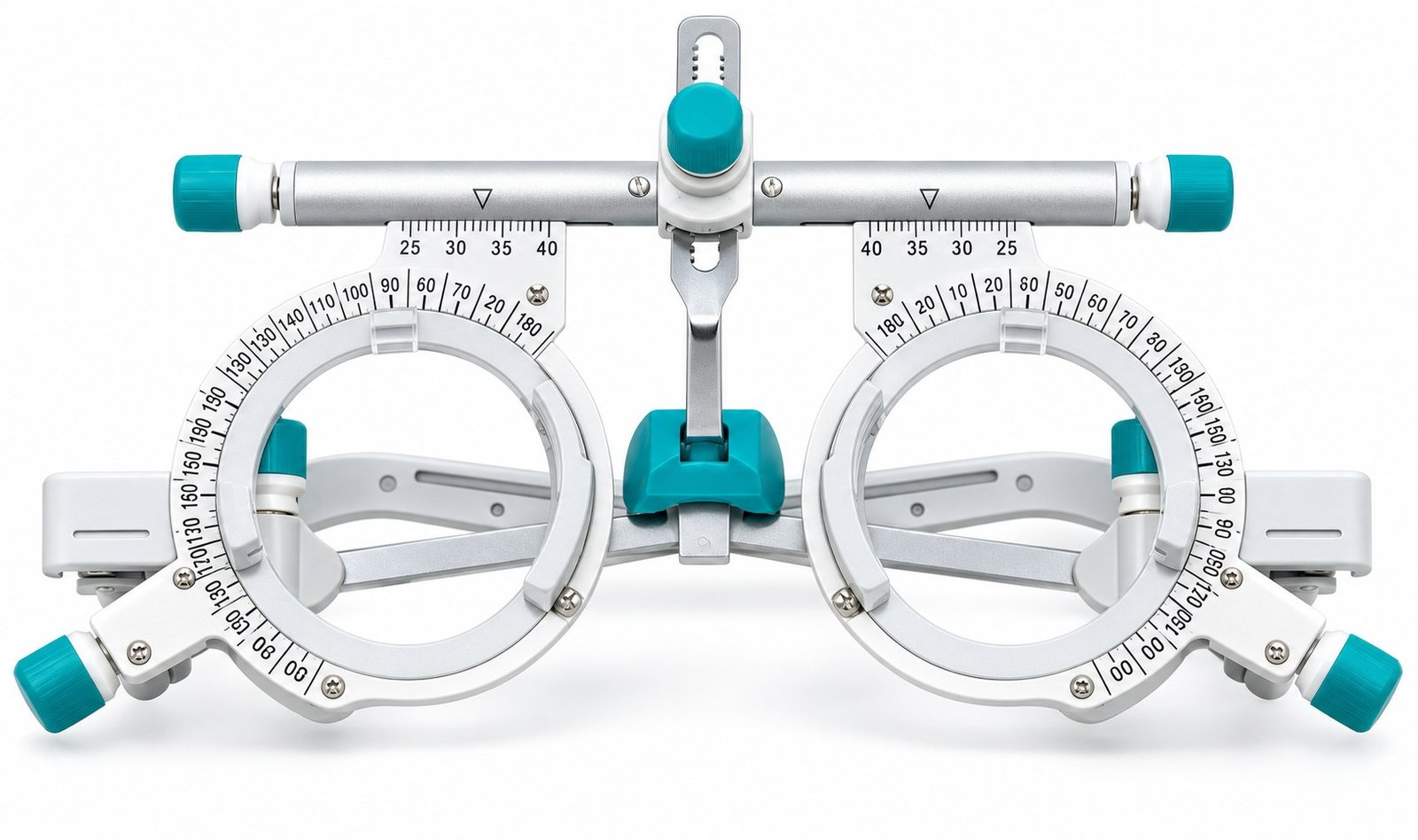
UTF-T4880R Ophthalmic trial frame, five lens cells per eye
An ophthalmic trial frame with five lens cells per eye, three in front and two behind. PD 48 to 80 mm (24 to 40 mm per eye), a Ø33.5 mm aperture, axis position knobs, a front inclination knob and an eye distance scale, a replaceable nose pad that adjusts to any angle, and adjustable temples.
Delivery, packing and documents
What the UTF-T4880R adjusts
Five lens cells per eye
Three cells in front and two behind, with 360° rotation of the lens in the inner ring.
Monocular PD
A PD knob and ruler for each side, 24 to 40 mm, 48 to 80 mm in total.
Axis position knobs
Turn the cylinder axis with a knob against scales marked every 5°: left 130°–0°–120°, right 50°–180°–60°.
Tilt and vertex
A front inclination angle knob and an eye distance scale for setting and reading the vertex distance.
Replaceable nose pad
The nose pad adjusts 0 to 25 mm and to any angle, and can be replaced.
Adjustable temples
Temple length adjusts over 0 to 30 mm.
A closer look at the UTF-T4880R
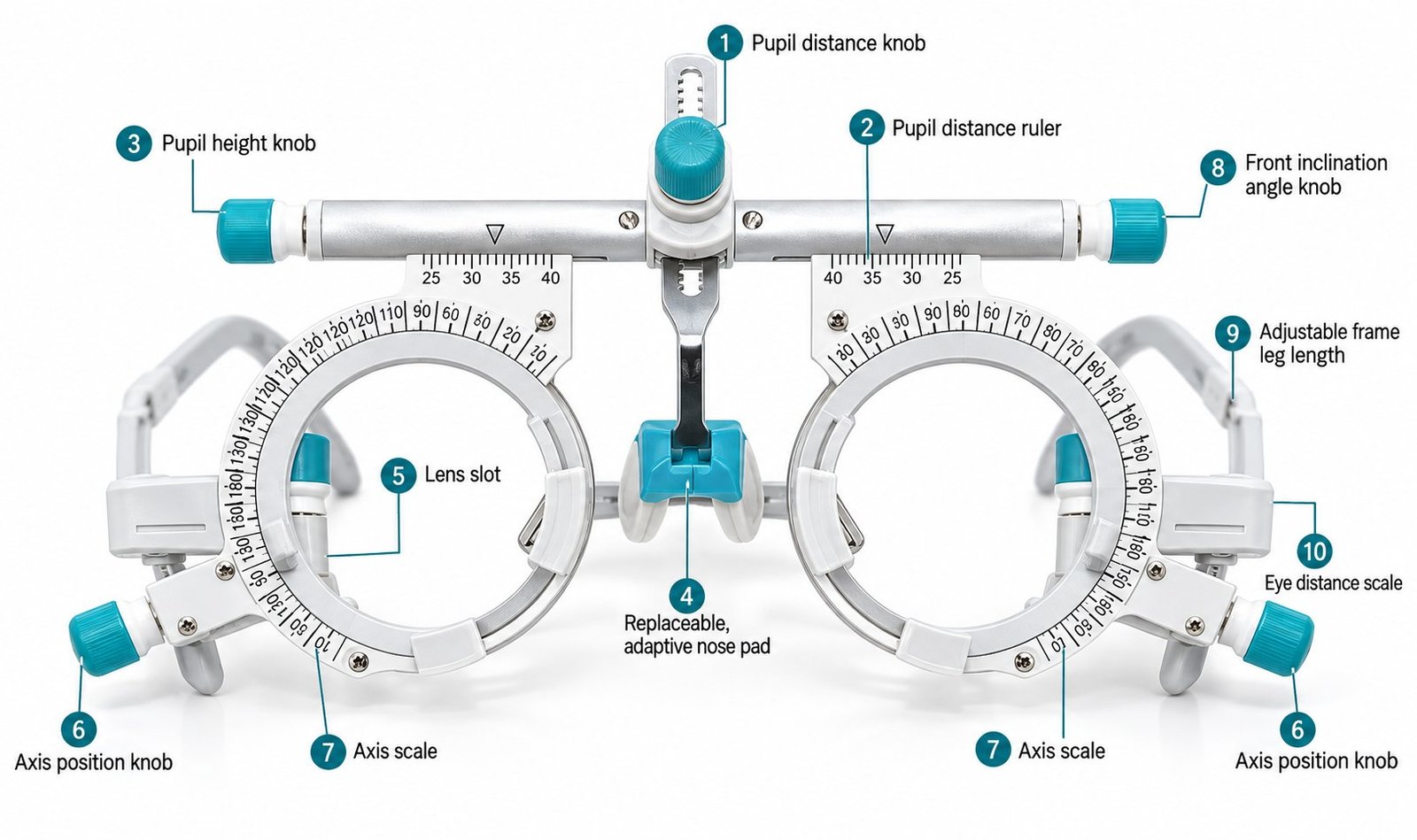
Parts at a glance
PD knob and ruler, pupil height knob, replaceable nose pad, lens slots, axis position knobs and scales, front inclination knob, adjustable temples and eye distance (vertex) scale.
UTF-T4880R in figures
Published specifications. Anything not listed here is confirmed in writing on your quotation, never estimated.
UTF-T4880R
- PD range
- 48–80 mm binocular; 24–40 mm each eye; 1 mm scale
- Axis scale
- Left 130°–0°–120°, right 50°–180°–60°, anticlockwise, every 5°
- Effective aperture
- Ø33.5 mm
- Lens cells per eye
- 5 (3 front, 2 back)
- Lens rotation
- 360°
- Lens axis nonparallelism
- ≤ 2.5°
- Optical vs geometric center
- ≤ 0.5 mm
- Lens displacement from frame center
- ≤ 0.3 mm
- Nose pad
- Travel 0–25 mm, any angle, replaceable
- Temple adjustment
- 0–30 mm
Choosing and using a trial frame
How it works
A trial frame holds trial lenses in front of the patient’s eyes at a controlled distance and angle. Set the PD so each lens center sits in front of the pupil, set the height, and adjust the nose pad and temples so the frame sits level.
A trial frame suits patients who find a phoropter difficult: young children, older and low-vision patients, wheelchair users, and high prescriptions, because you can see the patient and set the vertex distance yourself. Put the strongest sphere in the back cell, closest to the eye, and record the vertex distance; for powers of ±5.00 D and above it should go on the prescription.
Trial frames are also used to let a patient try a new prescription in real conditions, walking or reading, before the glasses are made.
Check before you order
- PD range against your patients: 48 to 80 mm here.
- Aperture against your trial lenses: Ø33.5 mm here.
- Lens cells: five per eye, useful when you stack spheres, cylinders and prisms.
- Vertex scale and tilt adjustment, if you refract high prescriptions.
Good practice
- Set each monocular PD, then level the frame with the height knob and nose pad.
- Set the front inclination so the lenses sit at the angle the finished glasses will have.
- Put the strongest sphere in a back cell and turn the cylinder axis with the axis knob.
- Read the vertex distance on the eye distance scale and record it for prescriptions of ±5.00 D and above.
Care and maintenance
- Wipe the frame after each patient; replace the nose pad when it wears.
- Do not force the knobs past their stops.
- Store the frame dry, away from direct sun.
Background sources: Trial frame refraction: more than just “1 or 2?” (Cybersight, Orbis) · Essential course in dispensing, part 14 (Optician) · Jackson cross cylinder (StatPearls, NCBI Bookshelf)
Often ordered with the UTF-T4880R
UTF-T4880R questions
Why five lens cells?
Two back cells let you add a second sphere or a prism behind the others without taking lenses out.
Which trial lenses fit?
Standard trial lenses with Ø38 mm rims; the effective aperture is Ø33.5 mm.
Can I read the vertex distance?
Yes, on the eye distance scale beside each lens cell.
Is the nose pad replaceable?
Yes. It adjusts 0 to 25 mm and to any angle, and can be replaced when it wears.