

UTF-T4880Jpro Adjustable progressive trial frame
An adjustable trial frame for fitting progressive lenses. Set each eye’s PD from 24 to 40 mm, the frame height, the pantoscopic tilt and the vertex distance, so a progressive trial lens sits where the finished glasses will. Each eye takes four trial lenses, two in front and two behind.
Delivery, packing and documents
What the UTF-T4880Jpro adjusts
Monocular PD
Each eye moves separately from 24 to 40 mm on a 1 mm scale, for a binocular PD of 48 to 80 mm. Progressive lenses are centred per eye, so the frame is too.
Height
The nose pad moves up and down over 19 mm and tilts 27° forward and back, to bring the fitting cross of the trial lens to the pupil.
Tilt and temples
The pantoscopic tilt is adjustable and the telescopic temples extend by up to 30 mm in seven steps, so the frame sits like a pair of glasses on any head.
Vertex distance ruler
A clear acrylic ruler on the side reads the distance from the lens to the eye.
Four lens cells
Two cells in front and two behind on each eye, for a progressive trial lens together with sphere or cylinder lenses.
Replaceable nose pads
Soft silicone nose pads in four sizes can be swapped to suit the wearer.
A closer look at the UTF-T4880Jpro
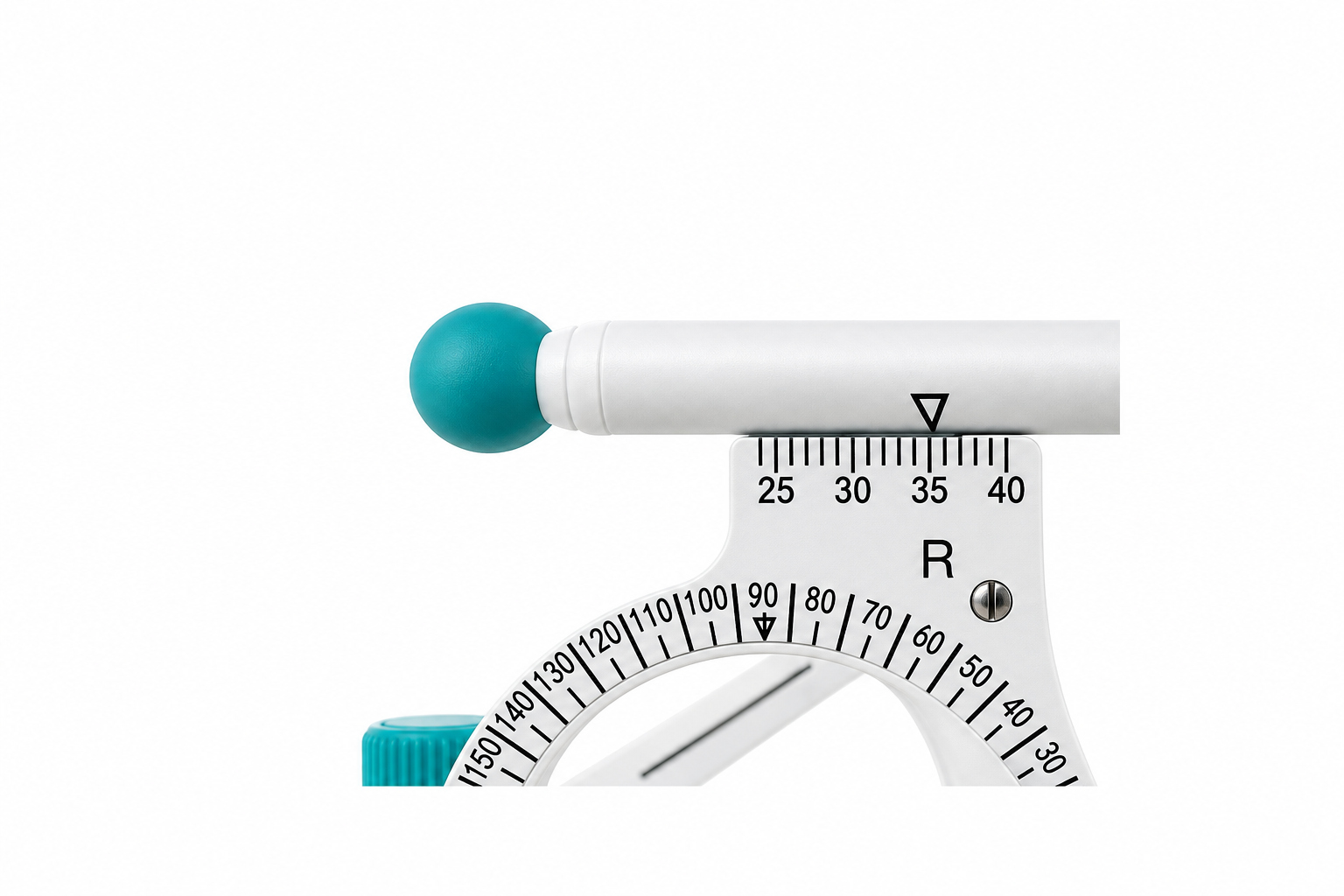
PD scale per eye
Read each eye from 24 to 40 mm; the axis scale runs 0–180° around the rim.

Height and nose pad
The nose pad sets the frame height over 0–19 mm.

Tilt and temples
Forward tilt and temple length adjust to the head.

Vertex distance
Read the lens-to-eye distance on the acrylic ruler.
UTF-T4880Jpro, TF-P series or UTF-T4880R
Three ways to put a trial lens in front of the eye. Figures are the published specifications of each model.
| UTF-T4880Jpro | TF-P series | UTF-T4880R | |
|---|---|---|---|
| Built for | Progressive fitting | Progressive demonstration | Full refraction |
| PD | 48–80 mm, adjustable per eye | One PD per frame, from 50–72 or 58–66 | 48–80 mm, adjustable per eye |
| Nose pad | Height 0–19 mm, 27° angle | Nose pads | 0–25 mm, any angle |
| Lens cells per eye | 4 (2 front, 2 back) | 3 or 4, by model | 5 (3 front, 2 back) |
| Effective aperture | Ø35.4 mm | Confirmed on quotation | Ø33.5 mm |
| Choose it if | You fit progressives and need PD, height and vertex distance per customer | You want light, ready-sized frames for showing a progressive | You refract with many lenses stacked |
The TF-P series uses one frame per PD; the UTF-T4880Jpro covers every PD from 48 to 80 mm in one frame.
UTF-T4880Jpro in figures
Published specifications. Anything not listed here is confirmed in writing on your quotation, never estimated.
Adjustment
- PD
- 48–80 mm binocular, 24–40 mm per eye, 1 mm scale
- Nose pad
- Height 0–19 mm; forward-backward angle 27°; four sizes, soft silicone
- Temples
- Length adjustable over 0–30 mm, seven steps
- Pantoscopic tilt
- Adjustable
- Vertex distance
- Acrylic ruler
Optics
- Effective aperture
- Ø35.4 mm
- Lens cells
- 4 per eye: 2 front, 2 back
- Axis scale
- 0–180°
- Lens rotation in inner ring
- 110°
- Axis parallelism
- ≤ 2.5°
- Optical vs geometric centre
- ≤ 0.5 mm
- Lens displacement
- ≤ 0.3 mm
Size and weight
- Size
- 195 × 115 × 65 mm
- Weight
- 43.6 g
- Trial lenses
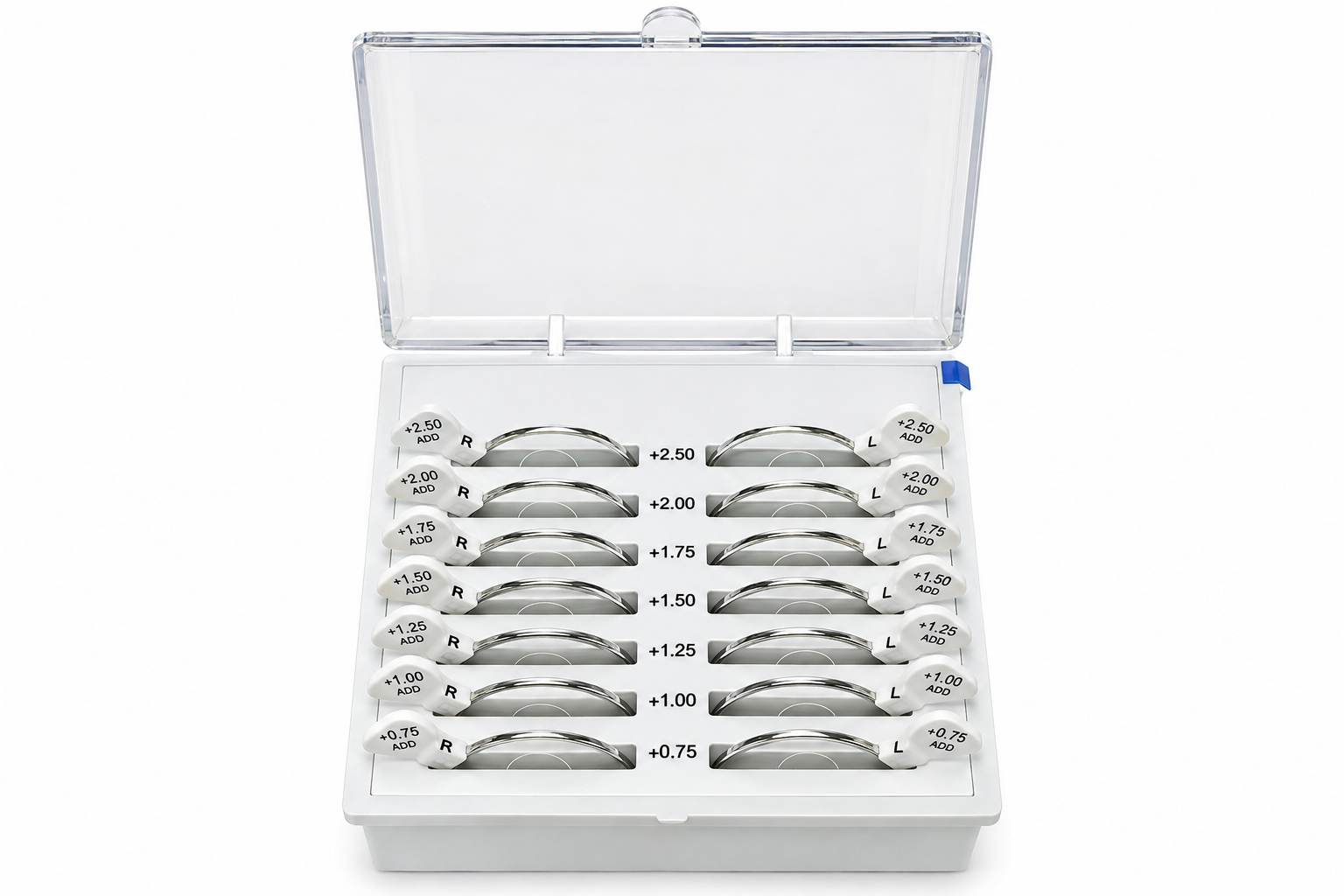
- Not included; JI-7 progressive trial lenses sold separately or in the PL-T9 kit
Fitting a progressive in an adjustable trial frame
Why an adjustable frame for progressives
A progressive lens only works when its fitting cross sits in front of the pupil, at the right height and vertex distance. A fixed-size trial frame gets the PD close; an adjustable frame lets you set each eye, the height and the tilt for the customer in front of you, so the corridor and near zone are where they will be in the finished glasses.
Monocular PD matters
Faces are rarely symmetrical. Setting the right and left eye separately keeps each corridor centred, which is why progressive orders ask for a monocular PD.
Check before you order
- Trial lenses: the frame is used with the JI-7 progressive trial lenses (Ø38 mm rings); tell us which trial lenses you use and we confirm the fit.
- Lens cells: four per eye, two front and two back.
- Nose pads: four sizes are available.
- Need it as a complete set? The PL-T9 kit includes this frame.
Good practice
- Measure the monocular PD first, then set each eye on the frame.
- Raise or lower the nose pad until the fitting cross is at the pupil centre.
- Set the tilt and temples so the frame sits as the glasses will, and read the vertex distance.
- Insert the progressive trial lens with its markings upright, then let the customer look far, at a screen and at reading material.
Care
- Wipe the nose pads between customers and replace them when worn.
- Store the frame in its box.
Often ordered with the UTF-T4880Jpro
UTF-T4880Jpro questions
What is an adjustable progressive trial frame?
An adjustable progressive trial frame is a trial frame for fitting progressive lenses in which the PD of each eye, the frame height, the tilt and the vertex distance can be set. The UTF-T4880Jpro adjusts from 24 to 40 mm per eye (48–80 mm in total), with four lens cells per eye.
How is it different from the TF-P series?
Each TF-P frame is made for one PD, so you keep a set of sizes. The UTF-T4880Jpro adjusts to any PD from 48 to 80 mm, per eye, and also sets the height and vertex distance.
How is it different from the UTF-T4880R?
The UTF-T4880R is a refraction frame with five lens cells per eye and a Ø33.5 mm aperture. The UTF-T4880Jpro is built for progressive fitting, with four cells, a Ø35.4 mm aperture and a vertex distance ruler.
Which trial lenses fit?
It is used with the JI-7 progressive trial lenses, which have Ø38 mm rings. Tell us which trial lenses you use and we confirm the fit before you order.
Are progressive trial lenses included?
No. The frame is sold on its own. The JI-7 progressive trial lenses are sold separately, or together with the frame in the PL-T9 progressive fitting kit.
What does it weigh?
The frame weighs 43.6 g.