
The short answer
Two kinds of instrument test lenses at the counter. A transmittance meter puts a number on how much light passes through a lens at a stated wavelength: the CP-18B reads 400 nm, 430 nm, 465 nm and the visible band. A demonstrator such as the CP-18C shows a customer UV blocking or a photochromic lens darkening, without a number. For a reading, clean the lens, check the meter on a clear lens, place the lens flat over the sensor and quote the wavelength with every figure. Describe blue-light results as transmission, not as a health benefit.
What each test tells you
Every lens test answers one narrow question. Choose the instrument by the question, and do not stretch the answer beyond it.
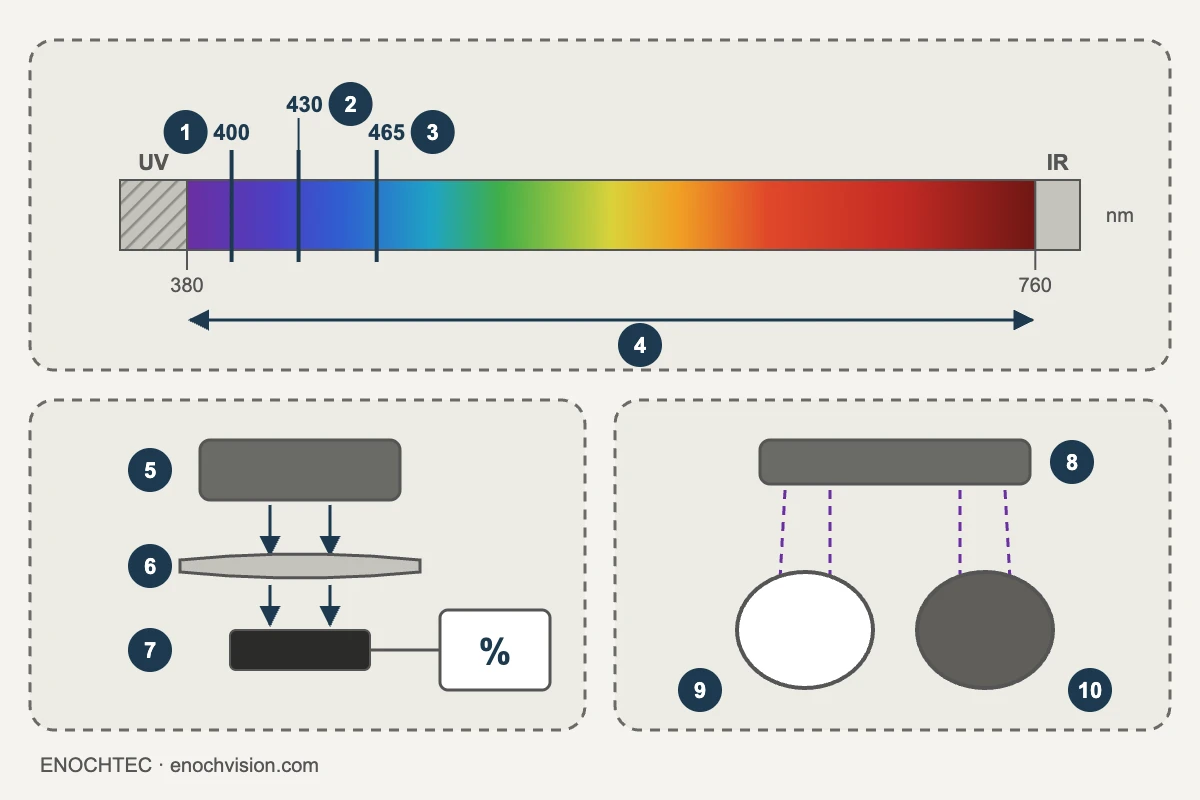
- 400 nm: the violet edge of the visible range, and the figure most UV400 claims rest on.
- 430 nm: a blue-light reading.
- 465 nm: a second blue-light reading.
- Visible light, 380–760 nm: how much of the visible range passes through, which tells you how dark or clear the lens is overall.
- Light source of a transmittance meter, at known wavelengths.
- The lens, flat and centered over the window.
- Sensor: the meter reports the share of light that reaches it, in percent.
- UV source of a demonstrator.
- Clear lens: no visible change under UV.
- Photochromic lens: darkens under UV.
| Question | Instrument | What you get | What it does not tell you |
|---|---|---|---|
| How much UV gets through at 400 nm? | Transmittance meter (CP-18B); the HV-600 lensmeter also reads 400 nm | Percent transmitted at 400 nm | Whether the lens meets every UV400 definition; sources set the limit at 400, 395 or 380 nm |
| How much blue light gets through? | CP-18B at 430 and 465 nm; HV-600 at 425 nm | Percent transmitted at those wavelengths | Any health benefit |
| How much visible light gets through? | CP-18B, 380–760 nm | Overall visible transmittance | Exact values on tinted, gradient or photochromic lenses, which are indicative only |
| Does the photochromic lens darken? | Demonstrator (CP-18C) | A visible change the customer can see | A measured value, or how dark the lens will be outdoors |
| Is the mounted lens under stress? | Polariscope (LY-15) | Visible stress fringes around mounting points | A numerical stress value or a pass/fail result |
How to take a transmittance reading
- Check the meter first. At the start of the day, measure a clear, uncoated lens and confirm the reading looks as it should.
- Clean the lens. Fingerprints and dust lower the reading.
- Place the lens flat over the sensor window, centered. The CP-18B measures areas down to 1 mm across, so you can also read a small sample.
- Read each value: violet at 400 nm, blue at 430 and 465 nm, and visible transmittance.
- Compare side by side. To show a customer the difference, measure their current lens and the new lens the same way, one after the other.
- Record the wavelength with the number, for example “2% at 400 nm”, not just “UV400”.
The CP-18B’s stated accuracy, ±2 at 1% resolution, applies to colorless, uniform materials between 0 and 90% transmittance. On tinted, gradient or photochromic lenses it still gives a reading, but treat it as indicative.
How to run a photochromic demonstration
Indoors there is almost no UV, so a counter tester with its own UV source is the practical way to show a photochromic lens before a customer buys.
- Keep a photochromic sample lens and a clear lens at the counter.
- Show the clear lens under the UV source first, then the photochromic lens, so the customer sees the change.
- Explain what changes the result: the UV level, the temperature and the lens material. Lenses darken more in the cold and less in the heat.
- Mention the car. Windshields block most UV, so most photochromics darken only a little behind one.
- Let the lens fade back before the next demonstration. Lens makers specify fade-back times at room temperature, around 23 °C.
A demonstration shows that a lens blocks some UV. It does not prove a UV400 rating; for a number, use a transmittance meter and quote its wavelength.
How to word the results
- UV: say what you measured, for example “this lens lets through 1% at 400 nm”. “UV400” is defined differently by different sources, some at 400 nm and some at 380 or 395 nm, and standards for sunglasses use their own limits. A reading at a stated wavelength is a statement you can stand behind.
- Blue light: describe transmission, not health. A 2023 Cochrane review of 17 trials found that blue-light filtering spectacles probably make no short-term difference to eye strain, and the UK College of Optometrists advises practitioners not to promise less fatigue, better sleep or macular protection.
- Comparisons: two lenses measured side by side are more convincing, and more honest, than an absolute claim about one.
Checking mounting stress with a polariscope
A lens squeezed too hard in a rim, or around the screws of a drilled mount, carries stress you cannot see in normal light. Polarized light makes it visible. On the LY-15, place the mounted lens on the lower stage, look through the upper polarizing ring and turn it as needed. Colored fringes concentrated around the mounting points show where the stress is. This is a visual check: the instrument gives no stress value and no pass/fail result, and it does not measure power or transmittance.
Common mistakes
- Measuring a dirty lens, or with dust on the sensor window.
- Holding the lens tilted or off center over the window.
- Treating readings on tinted, gradient or photochromic lenses as exact.
- Writing “UV400” without the wavelength and the reading.
- Using a demonstration as proof of a UV rating.
- Promising a health benefit from a blue-light reading.
- Starting the next photochromic demonstration before the lens has faded back.
- Showing photochromics in a warm shop without saying they darken differently outdoors and in the car.
To compare the three testers side by side, see Lens Testers.
Background sources: Demonstrating lenses (20/20 Magazine) · Blue-light filtering spectacles, Cochrane review 2023 · College of Optometrists on blue-light filtering lenses (2023)
© 2026 Beijing Enoch Corporation. All rights reserved. Copying or republishing this text or its diagrams, in whole or in part, without our written permission is prohibited.
Questions
Does a reading at 400 nm prove a lens is UV400?
It gives the transmittance at 400 nm, which is the figure most UV400 claims rest on. Definitions vary between sources and standards, so quote the wavelength together with the reading.
Can I tell customers blue-light lenses protect their eyes?
We advise against it. Show the transmission figures. A 2023 Cochrane review found little evidence of short-term benefit, and the College of Optometrists warns practitioners against health claims.
Can I measure tinted or photochromic lenses?
A meter will give a reading, but stated accuracy usually applies to colorless, uniform materials. On the CP-18B that means 0 to 90% transmittance, so treat readings on tinted, gradient or photochromic lenses as indicative.
Why does a photochromic lens hardly darken in the car?
The windshield blocks most of the UV that activates it. Temperature matters too: photochromic lenses darken more in the cold and less in the heat.
Does a lens stress viewer measure stress?
No. A polariscope such as the LY-15 makes stress patterns visible as colored fringes. It gives no numerical value and no automatic pass/fail result.