
The short answer
Pupillary distance (PD) is the distance between the centers of the pupils, in millimeters. The most repeatable way to take it is with a corneal-reflection pupilometer: the customer looks into the instrument, you line up a hairline on the small light reflex in each eye, and you read the total PD and the PD for each eye. Set the fixation distance to infinity for distance glasses, or to the customer’s working distance for reading glasses. A careful examiner with a PD ruler comes close on binocular PD, but a pupilometer gives monocular and near values directly.
Binocular, monocular and near PD
One customer has several PDs. Which one the lab needs depends on the lens and on where the customer will look through it.
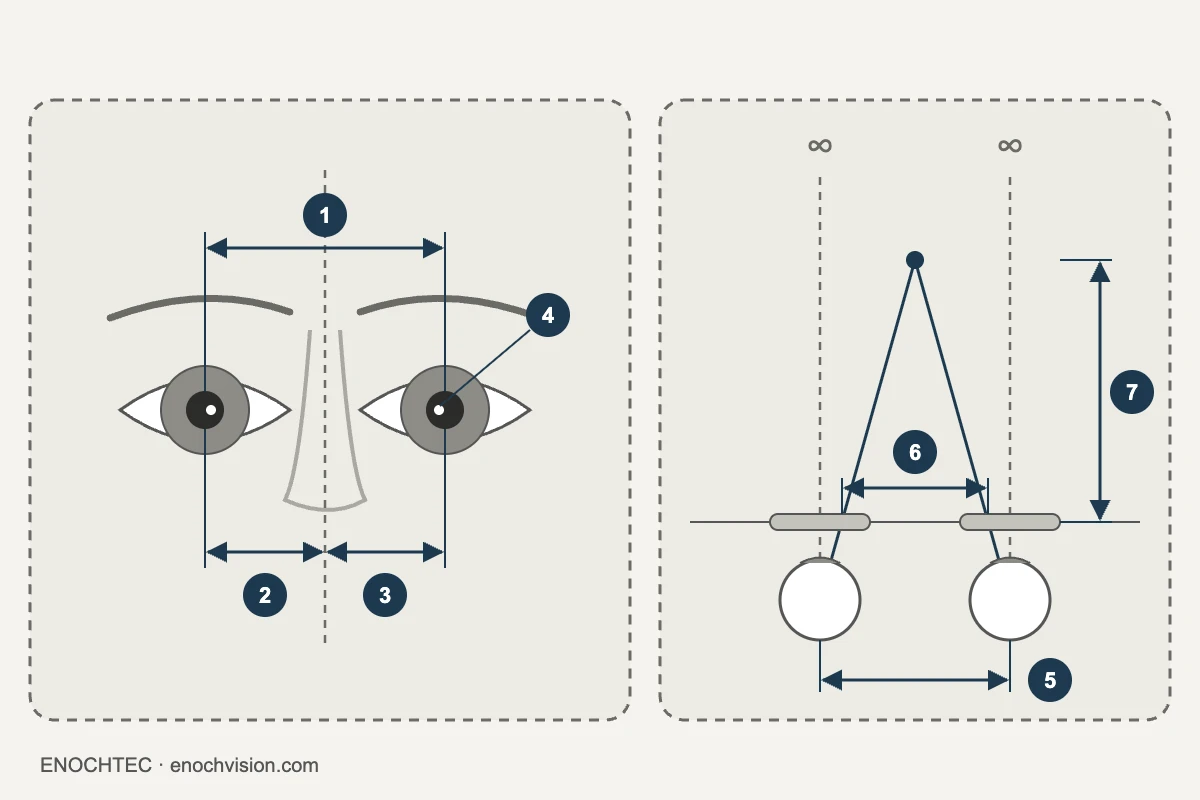
- Binocular PD: pupil center to pupil center. For single-vision distance glasses this one figure is often enough.
- Right monocular PD: from the center of the nose bridge to the right pupil.
- Left monocular PD: the same for the left eye. Faces are rarely symmetrical, so the two halves often differ. Progressives, strong prescriptions and aspheric lenses should be ordered with monocular values.
- Corneal reflex: the small reflection a pupilometer lines up on. It sits closer to where the line of sight crosses the cornea than the pupil center does, typically about 1 mm toward the nose.
- Distance PD: when the eyes look far away, the lines of sight are parallel.
- Near PD: for a near target the eyes turn in, so the lines of sight cross the lens plane closer together. Near PD is always shorter than distance PD.
- Working distance: how far away the customer reads or works. It is the fixation distance you set for a near PD.
How to measure PD with a pupilometer
The steps below follow a digital pupilometer such as the CP-32A1, which reads binocular PD from 45 to 82 mm and monocular PD from 22.5 to 41 mm.
- Check the instrument. The display should be bright; replace the batteries if it dims. Check it against a known reference from time to time (see below).
- Sit at the customer’s eye level, facing them. Seat the forehead and nose rests evenly, so the instrument is neither tilted nor turned on the face.
- Set the fixation distance. Use infinity for a distance PD. For a near PD, set the customer’s working distance: the CP-32A1 offers 30, 35, 40, 50 and 65 cm, 1 m, 2 m and infinity.
- Ask the customer to look at the light inside the instrument with both eyes open.
- Line up each hairline on the corneal reflex with the slider for that eye. For a monocular reading, use the occluder to cover the other eye.
- Read right, total and left PD from the display. Take each reading at least twice, and compare the result with any facial asymmetry you can see.
- Write down both monocular values and the fixation distance on the job ticket, so the lab knows whether it is a distance or a near PD.
The PD ruler method and its limits
A millimeter PD ruler is the traditional backup. For a distance PD:
- Sit at arm’s length, about 40 cm, with your eyes level with the customer’s. Rest the ruler on the bridge of the nose.
- Close your right eye. Ask the customer to look at your open left eye, and set the zero mark on the center of their right pupil.
- Open your right eye and close your left. Ask the customer to look at your right eye, and read the scale at the center of their left pupil.
- If the pupils are hard to see, use the same edge on both eyes instead, for example the left-hand edge of each iris as you see it.
Swapping eyes keeps the customer’s lines of sight roughly parallel, which is what makes the result a distance PD. The method depends on your eyes staying at the same distance and height, and on the customer holding fixation. Monocular PD by ruler also depends on where you judge the center of the nose to be. In a 2012 study, an examiner’s PD ruler differed from a pupilometer by about 0.6 mm on average, while self-measurement and an early phone app were far less repeatable.
Near PD: measure it or work it out
Near PD is shorter because the eyes converge on a near target. The best way to get it is to measure it at the customer’s real working distance with the pupilometer’s near setting. If you only have a distance PD, a common estimate is:
near PD ≈ distance PD × working distance ÷ (working distance + 27 mm)
Here 27 mm stands for a typical distance from the spectacle lens to the eye’s center of rotation; a longer vertex distance makes the near PD slightly smaller. For a 70 mm distance PD this gives about 65.5 mm at 40 cm, about 64 mm at 30 cm and about 63 mm at 25 cm. That is why a 70 mm distance PD usually becomes a near PD somewhere around 63 to 65.5 mm.
| Method | What it gives | Repeatability | Use it for |
|---|---|---|---|
| Pupilometer | Binocular and monocular PD, distance and near at set fixation distances | The most repeatable method; the CP-32A1 states a visual error under 0.5 mm | Every job, and always for progressives and strong prescriptions |
| PD ruler, used by an examiner | Binocular PD; monocular and near PD with care | About 0.6 mm from a pupilometer on average in one study | A quick cross-check, or a backup |
| Self-measurement or an early phone app | Binocular PD | Far less repeatable in the same study | Not for ordering lenses |
| Lensmeter on finished glasses | Where the optical centers of a pair actually are | Depends on marking the centers carefully | Checking a job against the ordered PD, not measuring the customer |
Errors that move a PD reading
- Head turned or the instrument seated unevenly: total PD may look right while the two monocular values shift in opposite directions.
- Parallax: with a ruler, your eye must be straight in front of the mark you read.
- The wrong fixation distance: a near PD on a distance job, or the other way round.
- Fixation drifting: if the customer looks at your nose instead of your open eye, the reading changes.
- Halving the binocular PD for progressives: on an asymmetric face this puts one optical center in the wrong place. For progressives, each 1 mm of monocular PD error narrows the reading area by about 2 mm.
- Mixing pupil centers and iris edges between the two eyes.
- Taking one reading only: always take two and compare.
Check the pupilometer, then the finished glasses
A study of nine corneal-reflection pupilometers found measurable errors, mainly from poor eye relief and friction in the scale, and recommended periodic accuracy checks, especially at very small and very large PDs. A simple routine is to measure a reference you trust, such as a colleague whose PD has been measured several times, every so often, and note the result. Keep the viewing optics clean, and take the batteries out if the instrument will be stored.
After edging, check that the PD went into the glasses. Mark the optical centers with a lensmeter such as the HV-600, then measure from the center of the bridge to each dot and compare with the ordered monocular PDs. The lensometer guide shows how to find and mark the optical center.
Background sources: Meet your pupilometer (20/20 Magazine) · Monocular PDs (20/20 Magazine) · Obstfeld & Chou, Ophthalmic and Physiological Optics 1998 · McMahon, Irving & Lee, Optometry and Vision Science 2012
© 2026 Beijing Enoch Corporation. All rights reserved. Copying or republishing this text or its diagrams, in whole or in part, without our written permission is prohibited.
Questions
Is a pupilometer more accurate than a PD ruler?
It is more repeatable, and it gives monocular and near readings directly. In a 2012 study, an examiner’s PD ruler was within about 0.6 mm of a pupilometer on average, so a careful examiner comes close on binocular PD.
Do I need monocular PD, or is binocular PD enough?
Binocular PD is often enough for single-vision distance glasses. Faces are rarely symmetrical, so progressives, strong prescriptions and aspheric lenses should be ordered with a PD for each eye.
How much smaller is near PD than distance PD?
It depends on the working distance. For a 70 mm distance PD, near PD is about 65.5 mm at 40 cm and about 63 mm at 25 cm. Measure it at the customer’s working distance, or estimate it as distance PD × working distance ÷ (working distance + 27 mm).
Can customers measure their own PD?
They can get a rough binocular figure, but in a 2012 study self-measurement and an early phone app were far less repeatable than an examiner. For ordering lenses, measure PD in the shop.
Why do two PD readings on the same person differ?
Usually because of head rotation, parallax, a change in fixation or a different fixation distance setting. Seat the instrument evenly, check the distance setting, and take every reading twice.