
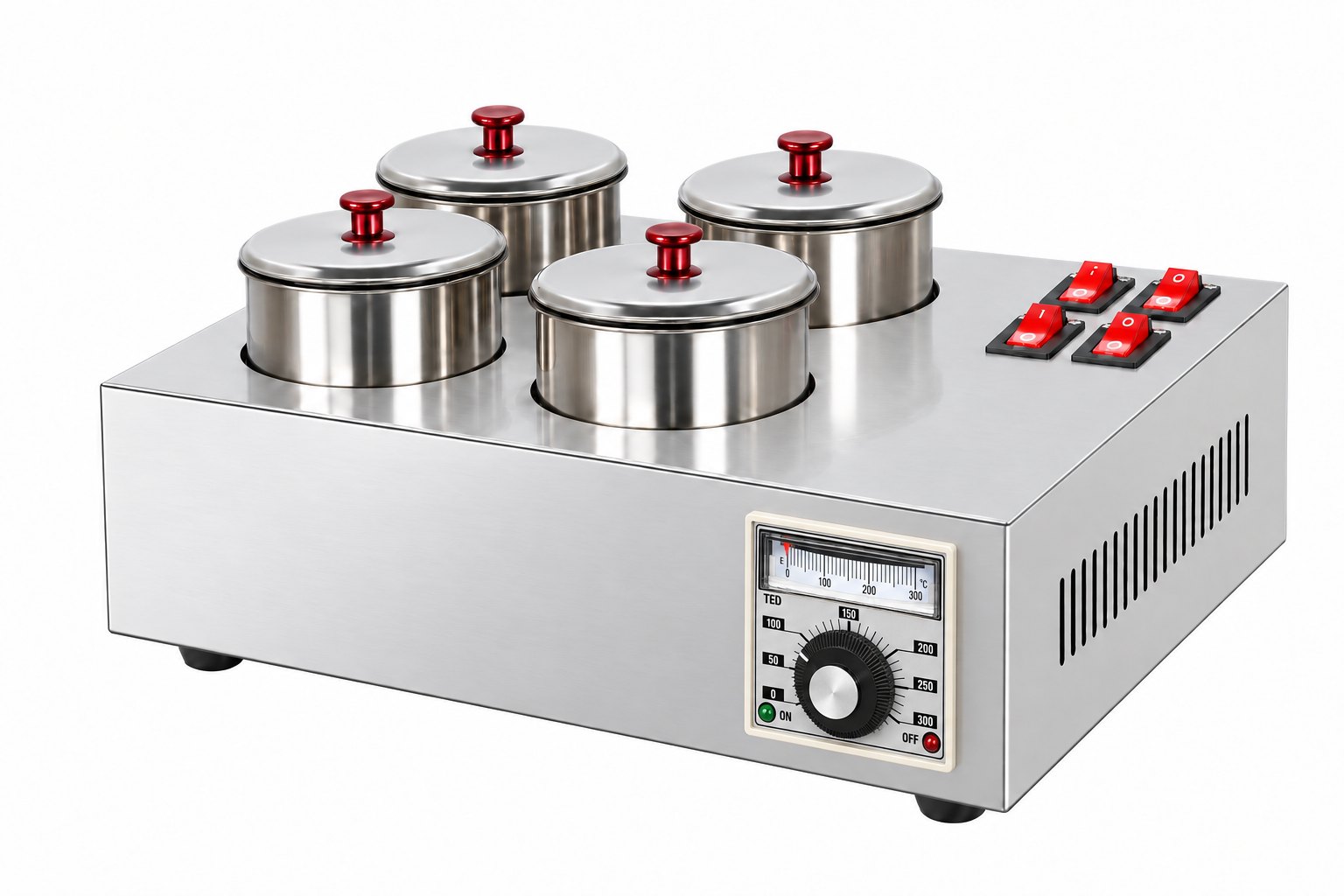
DM Series Lens tinting machine with 2, 4 or 6 dye pots
A bench tint unit for shops and labs that dye resin lenses in-house: stainless steel dye pots sit in a heated bath, each pot holding one colour, so you can run several tints or gradients side by side. Choose two, four or six pots. The DM-2W, DM-4 and DM-6 have a front temperature control dial.
Delivery, packing and documents
What the DM tinting machines do
One colour per pot
Each stainless steel pot holds its own dye, so brown, grey, green and fashion colours stay ready side by side instead of being emptied and refilled.
2, 4 or 6 pots
Two pots for a shop that tints occasionally, four or six for a lab that keeps a range of colours and gradients hot through the day.
Temperature control
The DM-2W, DM-4 and DM-6 have a front control dial with a temperature scale and on/off indicator lights, so the dye bath can be held at the temperature your dye maker specifies.
Lidded 500 ml pots
Each pot holds 500 ml and has its own lid, which keeps heat in and slows evaporation between jobs.
Stainless steel pots
The dye pots are 302 stainless steel, which resists the dyes and neutralisers used in lens tinting and cleans easily.
Switches on the top panel
Rocker switches on the top panel turn the heating on and off, within easy reach and away from the dye pots.

Temperature dial
On the DM-2W, DM-4 and DM-6: a temperature scale, a setting dial and ON/OFF indicator lights on the front panel. The DM-2 has no dial.
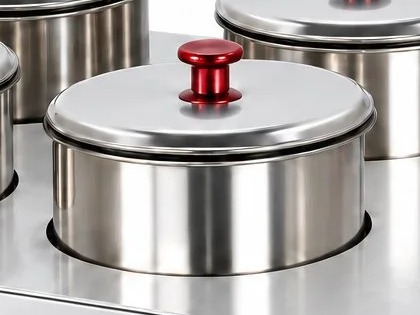
Lidded dye pot
A 500 ml pot in 302 stainless steel, set into the top panel, with its own lid to hold heat between jobs.
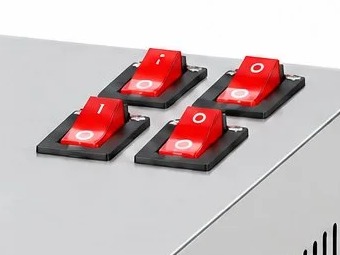
Rocker switches
The heating is switched on and off from the top panel, away from the front of the machine where you work with the pots.
DM-2, DM-2W, DM-4 or DM-6
Same 500 ml stainless steel pots on every model. The difference is the number of pots, temperature control and heating power.
| DM-2 | DM-2W | DM-4 | DM-6 | |
|---|---|---|---|---|
| Dye pots | 2 | 2 | 4 | 6 |
| Temperature control | No dial | Yes, dial | Yes, dial | Yes, dial |
| Heating power | 700 W | 700 W | 1400 W | 2100 W |
| Pot capacity | 500 ml | 500 ml | 500 ml | 500 ml |
| Unit gross weight (G.W.) | 2.4 kg | 3.9 kg | 5 kg | 6.4 kg |
| Unit size | 33 × 17 × 21 cm | 36 × 28 × 22 cm | 39 × 37 × 22 cm | 51 × 37 × 22 cm |
| Choose it if | You tint now and then on a small bench | You tint a few colours and want steady results | You keep four colours or gradients ready | You run a tinting service with a wide colour range |
For repeatable colour, choose a model with temperature control. Dye uptake depends on bath temperature, and an uncontrolled bath drifts as the dye heats and cools.
DM series in figures
Published specifications. Anything not listed here is confirmed in writing on your quotation, never estimated.
Unit weights are gross weights (G.W.); unit sizes are as listed by the factory.
Dye pots
- Material
- 302 stainless steel
- Capacity
- 500 ml per pot
- Number of pots
- DM-2 / DM-2W: 2 · DM-4: 4 · DM-6: 6
Machine
- Temperature control
- DM-2W, DM-4, DM-6: front dial; DM-2: no dial
- Heating power
- 700 W (2 pots) · 1400 W (4 pots) · 2100 W (6 pots)
- Voltage
- Confirmed on your quotation
- Unit gross weight (G.W.)
- DM-2 2.4 kg · DM-2W 3.9 kg · DM-4 5 kg · DM-6 6.4 kg
- Unit size
- DM-2 33 × 17 × 21 cm · DM-2W 36 × 28 × 22 cm · DM-4 39 × 37 × 22 cm · DM-6 51 × 37 × 22 cm
Tinting lenses in-house
Which lenses take a tint
Standard CR-39 resin lenses absorb dye well and are what most shops tint. Polycarbonate, high-index and lenses with a hard coat take dye more slowly or unevenly, and some coated lenses will not tint at all, so ask your lens supplier whether a lens is tintable before you promise a colour. Glass lenses cannot be dyed this way.
How many pots
Count the colours you want ready at the start of the day. Brown and grey cover most sun tints; add green, a fashion colour or a neutraliser pot to strip a tint that came out too dark. Two pots suit occasional work, four suit a shop that offers a colour choice, and six suit a lab that tints for other shops.
Why temperature control matters
Dye uptake depends on bath temperature: a few degrees lower and the lens takes longer, a few degrees higher and colour builds faster than you expect. Most lens dyes are used hot, close to boiling; always follow the temperature your dye maker gives. A temperature control dial lets you hold that setting, so a colour you match today matches next week.
Check before you order
- Lens mix: resin tints easily; check polycarbonate, high-index and coated lenses with your lens supplier.
- Number of colours: one pot per colour, plus one for a neutraliser if you strip tints.
- Temperature control: choose the DM-2W, DM-4 or DM-6 if you need repeatable colour.
- Bench space: a heat-resistant, level surface away from water splashes, with ventilation for dye vapour.
- Power: 700 W to 2100 W depending on the model; the voltage version is confirmed on the quotation.
- Consumables: lens dyes, neutraliser and lens holders or tongs are ordered separately.
Good practice
- Clean the lens and handle it by the edge so fingerprints do not leave pale spots.
- Bring the dye to the temperature your dye maker specifies before the first lens goes in.
- Dip the lens in a holder and check the colour against a sample at short intervals.
- For a gradient, lower and raise the lens slowly so the colour builds towards the top edge.
- Rinse in warm water, dry, and compare with the sample or the other lens of the pair.
- If the tint is too dark, use a neutraliser pot to lighten it, then rinse again.
Care and safety
- Keep the lids on when a pot is not in use to cut evaporation and keep dust out.
- Top up with water as the dye evaporates, and replace dye that has become cloudy.
- Pots and dye are hot: use tongs or holders, never fingers, and switch the heating off when you finish.
- Let the unit cool before emptying or cleaning the pots.
Often ordered with the DM series
DM tinting machine questions
What is a lens tinting machine?
A lens tinting machine is a heated bath with dye pots that colours resin spectacle lenses. The lens is dipped in a hot dye until it reaches the shade you want, for sun tints, fashion colours or gradients. The DM series has 2, 4 or 6 stainless steel pots of 500 ml each.
Which DM model should I choose?
Choose by the number of colours you keep ready. The DM-2 and DM-2W have two pots, the DM-4 four and the DM-6 six. For repeatable colour, pick a model with a temperature control dial: the DM-2W, DM-4 or DM-6.
Can it tint polycarbonate or high-index lenses?
Standard resin lenses tint most easily. Polycarbonate, high-index and hard-coated lenses take dye more slowly or not at all, depending on the lens. Check with your lens supplier that a lens is tintable before tinting it.
Can it tint glass lenses?
No. Glass lenses do not absorb lens dye; they are coloured during manufacture or by coating.
Are lens dyes included?
Dyes, neutraliser and lens holders are ordered separately. Tell us the colours you need and we can quote them with the machine.
What voltage does it use?
Heating power is 700 W, 1400 W or 2100 W depending on the number of pots. The voltage version and plug type are confirmed on your quotation for your country.