
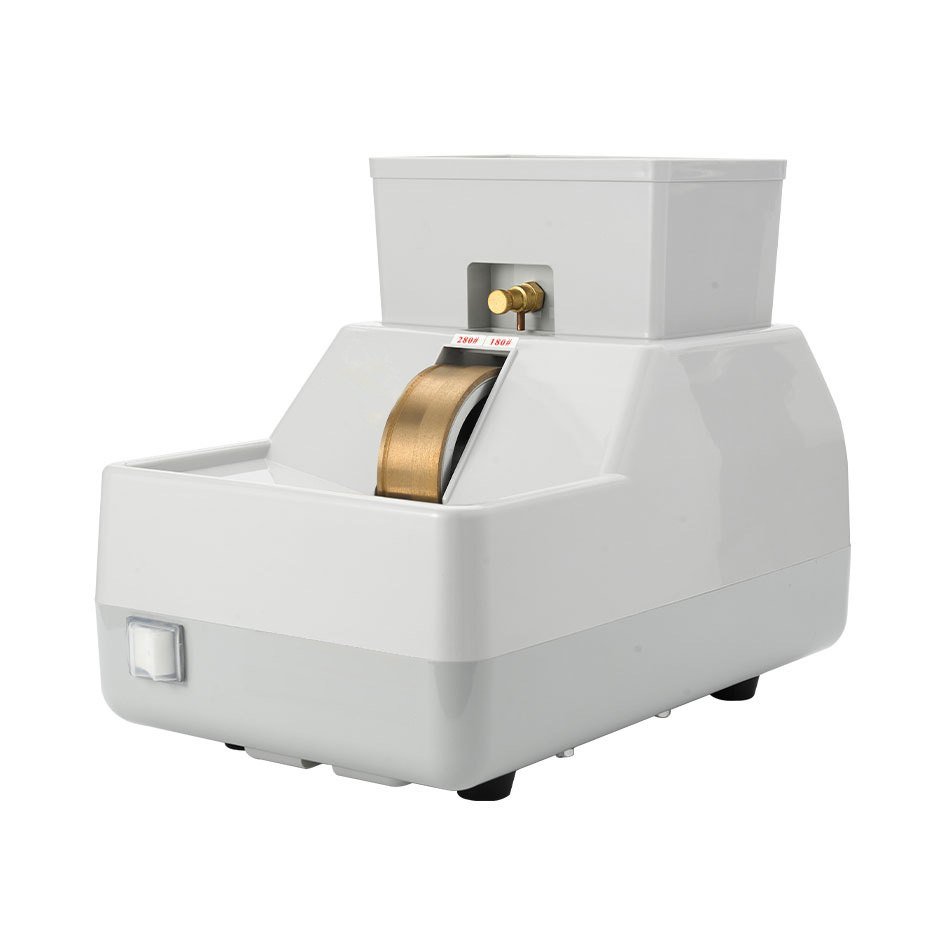
CP-7A-35WV Lens hand edger with V-groove diamond wheel
A bench hand edger with a 100 mm diamond wheel on a dual-support bracket, driven by a large AC motor. The wheel has a coarse zone, a fine zone and a V-groove, and the water flow is adjustable for different lens materials. Use it for touch-up sizing, safety bevels and the edge work an automatic edger cannot finish on its own.
Delivery, packing and documents
What the CP-7A-35WV does
Coarse, fine and V-groove
Right side coarse grinding (16 mm, 180 grit), left side fine grinding (19 mm, 280 grit) with a V-groove, on one diamond wheel.
Dual-support bracket
The wheel shaft is supported on both sides for greater stability under hand pressure.
Large AC motor
A 100 W AC motor turns the wheel at 4,200 rpm.
Adjustable water flow
A water tank above the wheel with an adjustable valve, so you can set the flow to suit the material.
Resin, glass and PC
Grinds resin, glass and PC lenses, and also stone and cutting tools.
Touch-ups and safety bevels
Take a lens down a fraction for fit, touch up a bevel in the V-groove, or put a safety bevel on the front and back edges.
CP-7A-35WV in figures
Published specifications. Anything not listed here is confirmed in writing on your quotation, never estimated.
“35WV” means the wheel has a V-groove on its fine side. The CP-7A-35W uses the same wheel layout without the V-groove.
CP-7A-35WV
- Grinding wheel
- Diamond, 14 × 100 × 35 mm
- Wheel speed
- 4,200 rpm
- Wheel zones
- Right 16 mm coarse (180 grit); left 19 mm fine (280 grit) with V-groove
- Water supply
- Tank with adjustable flow
- Grindable materials
- Resin, glass, PC, stone, cutting tools
- Voltage
- AC 220 V / 50 Hz, 110 V / 60 Hz
- Power
- 100 W
- Net weight
- approx. 6.4 kg
- Dimensions
- 350 × 215 × 260 mm
- Packaging
- 415 × 270 × 300 mm
- Packaging weight
- 9 kg
Versions
| Model | Difference |
|---|---|
| CP-7A-35WV | Dual support, AC motor, 100 W, 4,200 rpm; wheel with V-groove |
| CP-7A-35W | As the CP-7A-35WV, wheel without V-groove |
| CP-7-35WV | Dual support, DC motor, 55 W, 5,500–6,000 rpm, approx. 3.6 kg |
| CP-7B-35WV | Single support, AC motor; 35 mm wheel, 180/280 grit |
Getting the most from a hand edger
How it works
A hand edger is a small bench grinder. You hold the lens against a turning diamond wheel while water drips onto the wheel to cool it and carry away swarf. The wheel is divided into zones, so one wheel handles fast stock removal, a finer finish and bevel work.
On the CP-7A-35WV the right side of the wheel is the coarse zone (180 grit, 16 mm wide) for taking a lens down to size, and the left side is the fine zone (280 grit, 19 mm) with a V-groove, for finishing edges and touching up a bevel so the lens seats in a full-rim frame. The water valve lets you set the flow to suit the lens material.
Even labs with an automatic edger keep one. Typical jobs are taking a lens down slightly so it fits, putting a safety bevel on sharp front and back edges, relieving material behind the bevel, steepening the back bevel for wrap frames, and thinning the back edge of a thick lens so it sits in a plastic frame. The dual-support bracket keeps the wheel steady when you press a lens against it.
Check before you order
- The lens materials you grind: resin, glass and PC are listed for this wheel. Clean the wheel and water between glass and plastic.
- Wheel profile: choose the -35WV with V-groove for bevel touch-ups, or the -35W without it.
- Water: the tank and valve are built in, so no plumbing is needed at the bench.
- Voltage (220 V or 110 V) for your country; other export voltages can be made to order.
- Replacement wheels (14 × 100 × 35 mm), so a worn wheel does not stop the bench.
Good practice
- Fill the tank and open the valve so the wheel is wet before the lens touches it.
- Use light, even pressure and keep the lens moving so the edge stays uniform.
- Size on the coarse 180-grit zone, then finish on the 280-grit zone.
- Touch up a bevel in the V-groove, holding the lens at a steady angle all the way round.
- Bevel the front edge of plastic rimless lenses by hand even when the edger bevels the back.
- Check the fit in the frame often; it is easier to take more off than to put it back.
Care and maintenance
- Keep the wheel clean and sharp; a glazed wheel heats and chips lenses.
- Change the water and clean the tray and sponge regularly.
- Keep bearings lubricated as the manual specifies.
Background sources: On the edge (20/20 Magazine) · Crossing the finish line (20/20 Magazine) · Eight tips for processing rimless or semi-rimless eyewear (Eyecare Business)
Often ordered with the CP-7A-35WV
CP-7A-35WV questions
Does the CP-7A-35WV have a V-groove?
Yes. The “WV” wheel has a V-groove on the fine (280-grit) side. The CP-7A-35W is the same machine with a wheel that has no V-groove.
I already have an automatic edger. Do I still need a hand edger?
Most finishing benches keep one for touch-ups, safety bevels and wrap-frame work that the automatic edger cannot finish alone. It is also the backup when the edger is being serviced.
Can it grind glass lenses?
Yes. Resin, glass and PC are listed. Set the water flow for the material, and clean the wheel and water before going back to plastic so glass particles do not scratch plastic lenses.
Does it need a water connection?
No. Water comes from the tank above the wheel, and the valve adjusts the flow.
Which version should I choose?
The CP-7A-35WV has the large AC motor (100 W) and the V-groove wheel. The CP-7-35WV is lighter, with a DC motor (55 W), and the CP-7B-35WV is a single-support AC version.