
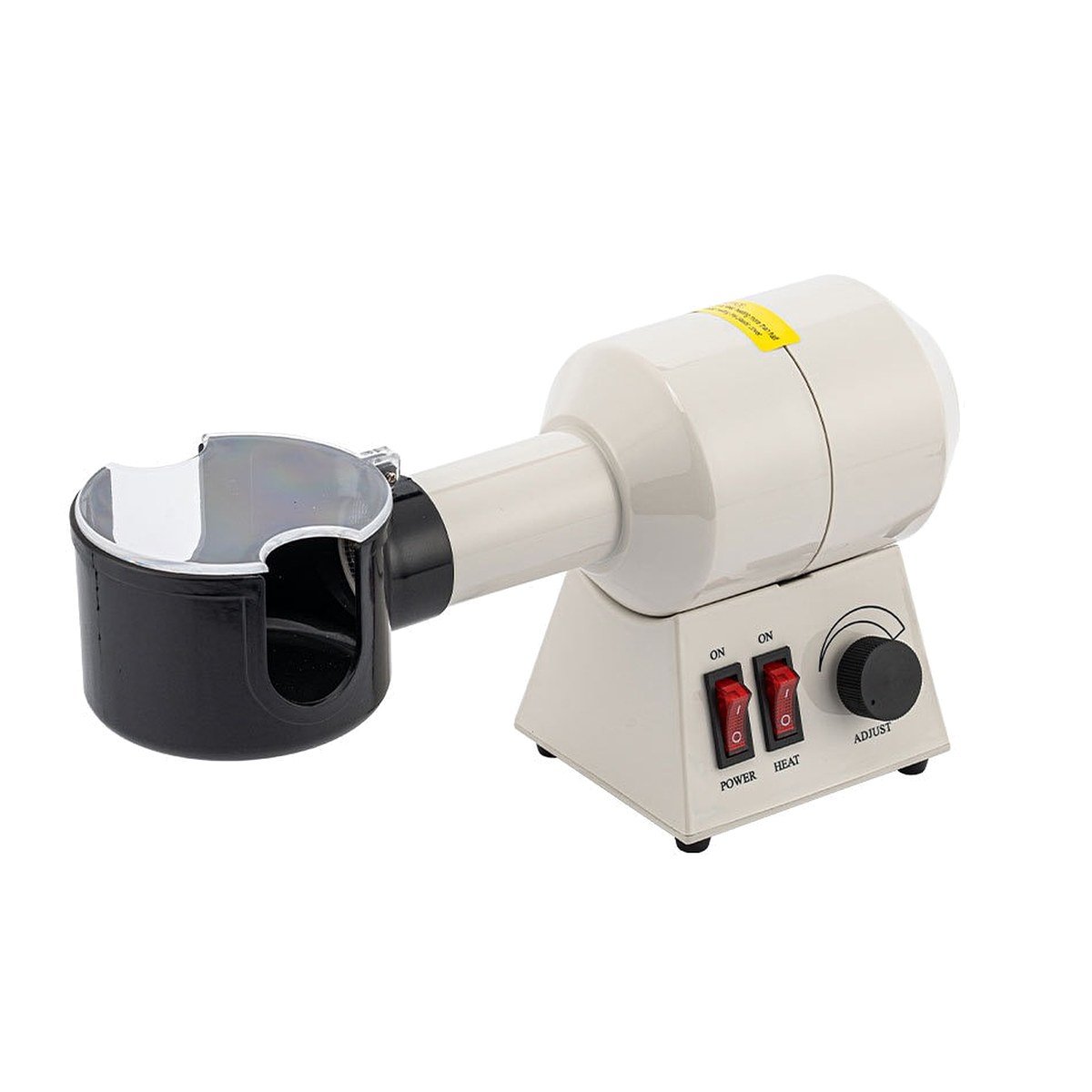
CP-19A Eyeglass frame warmer, adjustable 80–130 °C
A hot-air frame warmer for fitting lenses into plastic frames and adjusting temples, bridges and fronts. The temperature is adjustable from 80 to 130 °C, and an airflow deflector directs the heat where you need it.
Delivery, packing and documents
What the CP-19A does
Adjustable temperature
Set the heat from 80 to 130 °C to suit the frame material.
Airflow deflector
A deflector attachment directs the hot air onto the part you are adjusting.
Lens insertion
Warms acetate and other plastic fronts so lenses can be fitted.
Frame adjustments
Softens temples and bridges for fitting adjustments.
Clean heat
Hot air leaves no salt or bead residue on the frame.
600 W
Rated power 600 W.
CP-19A in figures
Published specifications. Anything not listed here is confirmed in writing on your quotation, never estimated.
The CP-19B is the non-adjustable version, without the airflow deflector.
CP-19A
- Temperature
- 80–130 °C, adjustable
- Voltage
- AC 220 V / 50 Hz, 110 V / 60 Hz
- Power
- 600 W
- Package dimensions
- 265 × 130 × 265 mm
- Package weight
- 1.6 kg
Versions
| Model | Difference |
|---|---|
| CP-19A | Adjustable temperature, with airflow deflector |
| CP-19B | Non-adjustable temperature |
Heating frames safely
How it works
A frame warmer softens plastic frame parts so an optician can insert lenses into acetate (zyl) frames and adjust temples, bridges and fronts. Hot-air warmers blow air through a nozzle; salt and glass-bead pans heat the frame by dipping it. Many opticians prefer hot air as their main tool because it is clean, leaves no residue on hinges and lets you heat one spot.
Different frame materials need very different treatment. Acetate adjusts at around 57–62 °C, optyl at 80–120 °C, and nylon, TR90, carbon fiber and similar materials are glazed cold with little or no heat. Metal frames are adjusted cold.
Keep heat off the lenses. Heating a mounted lens can distort it and cause micro-cracks, and lens makers warn that temperatures above about 80 °C can damage lenses and coatings. Heat the frame part, shield or remove the lens, and use the lowest setting that works.
Frame materials and heat
| Material | Adjusting temperature and behavior |
|---|---|
| Cellulose acetate (zyl) | About 57–62 °C. Too much heat distorts and bubbles it; old frames turn brittle. |
| Cellulose propionate | About 67 °C. Shrinks with excess heat; limited later adjustment. |
| Optyl (epoxy) | 80–120 °C. Has shape memory: reheated without support, it returns to its original shape. |
| Nylon, polyamide, TR90 | Glaze cold. ABDO gives a softening point of about 85 °C; other sources advise no heat at all. |
| SPX co-polyamide | Only 100–110 °C. Brittle below that range, degrades above it. |
| Carbon fiber | Glaze cold. |
| Metal | Adjust cold. |
Check before you order
- Adjustable temperature (the CP-19A is; the CP-19B is not).
- A deflector or nozzle to direct the heat.
- Counter space and a socket near the fitting table.
- Voltage for your country.
Good practice
- Identify the frame material before heating.
- Start at a low setting and raise it only if the frame does not soften.
- Keep the frame moving in the airflow so it heats evenly.
- Shield or remove coated lenses; do not heat mounted lenses.
- Bend gently and hold the part in position while it cools.
Care and maintenance
- Keep the air vents clear of dust.
- Let the unit cool before storing it.
- Check the cord and plug regularly.
Background sources: Frame materials, CET 156 (ABDO) · Frame materials CPD (Optician Online) · What's on your bench (Eyecare Business)
Often ordered with the CP-19A
CP-19A questions
Which frames can be heated?
Acetate, propionate (carefully) and optyl can be heat-adjusted. Nylon, TR90 and carbon fiber are glazed cold or heated very little, and metal frames are adjusted cold.
What temperature should I use?
It depends on the material; see the table above. Start low and raise the setting only if the frame does not soften.
Can I heat a frame with the lenses in?
Avoid it with coated lenses: heat can craze coatings and cause micro-cracks. Remove the lens or shield it and heat only the frame part.
Hot air or a salt or bead pan?
Hot air is cleaner and more targeted, and most opticians prefer it. Bead pans heat thick frames evenly but can trap beads and leave marks.