
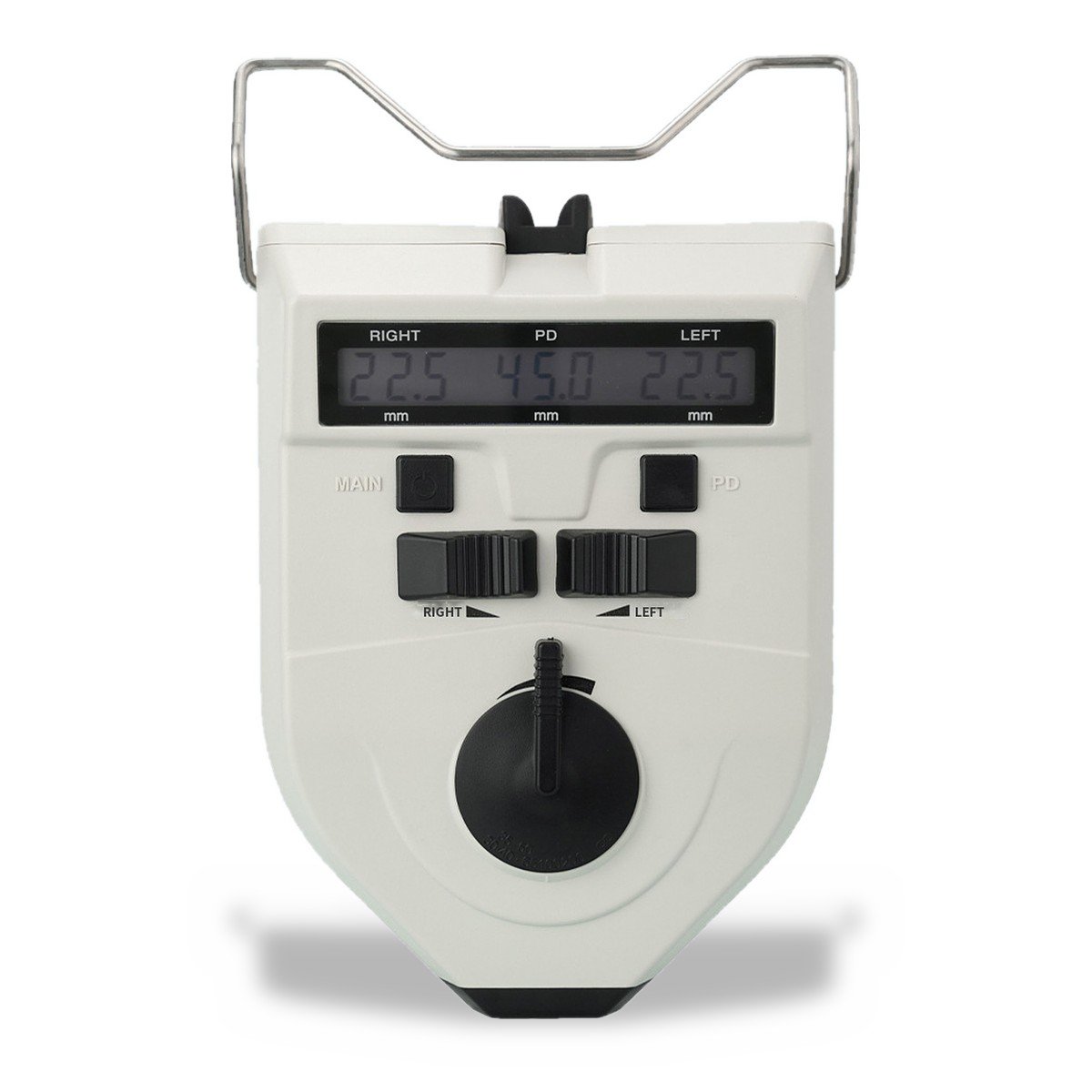
CP-32A1 Digital PD meter (pupilometer)
A digital pupilometer that measures binocular PD from 45 to 82 mm and monocular PD from 22.5 to 41 mm, at eight fixation distances from 30 cm to infinity. LED illumination, presbyopia compensation and auto shut-off, on two AA batteries.
Delivery, packing and documents
What the CP-32A1 measures
Binocular and monocular PD
Measures the total PD and each eye separately, which progressives and strong prescriptions need.
Near and far
Eight fixation distances, 30, 35, 40, 50 and 65 cm, 1 m, 2 m and infinity, so you can take a reading PD at the customer’s working distance as well as a distance PD.
LED illumination
An LED light source for the corneal reflex.
Presbyopia compensation
Compensation for presbyopic customers.
Auto shut-off
Switches itself off to save the batteries.
Battery powered
Runs on two AA batteries, so it works anywhere on the counter.
A closer look at the CP-32A1
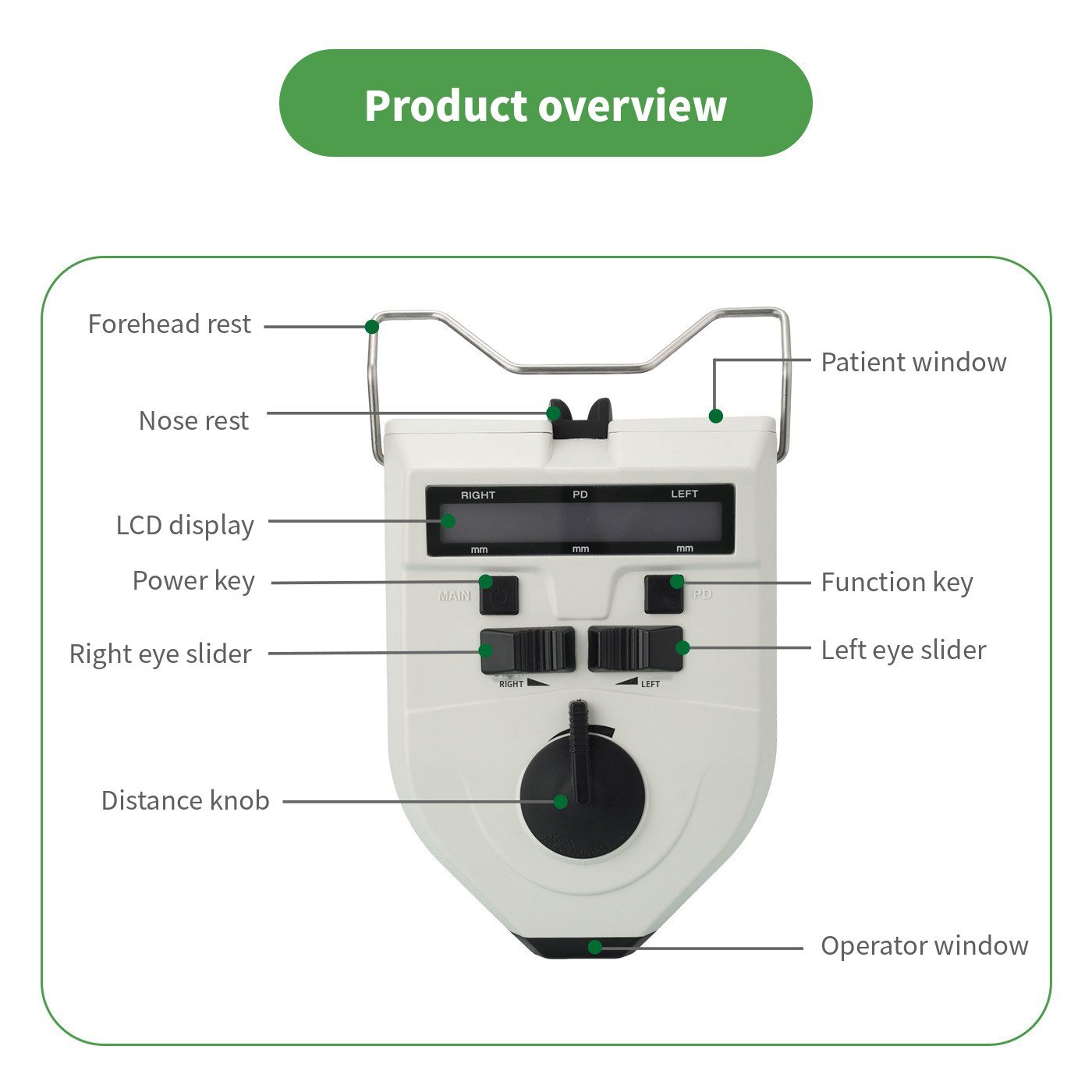
Parts at a glance
Forehead and nose rests, an LCD for right, total and left PD, power and function keys, a slider for each eye, the distance knob, and the patient and operator windows.
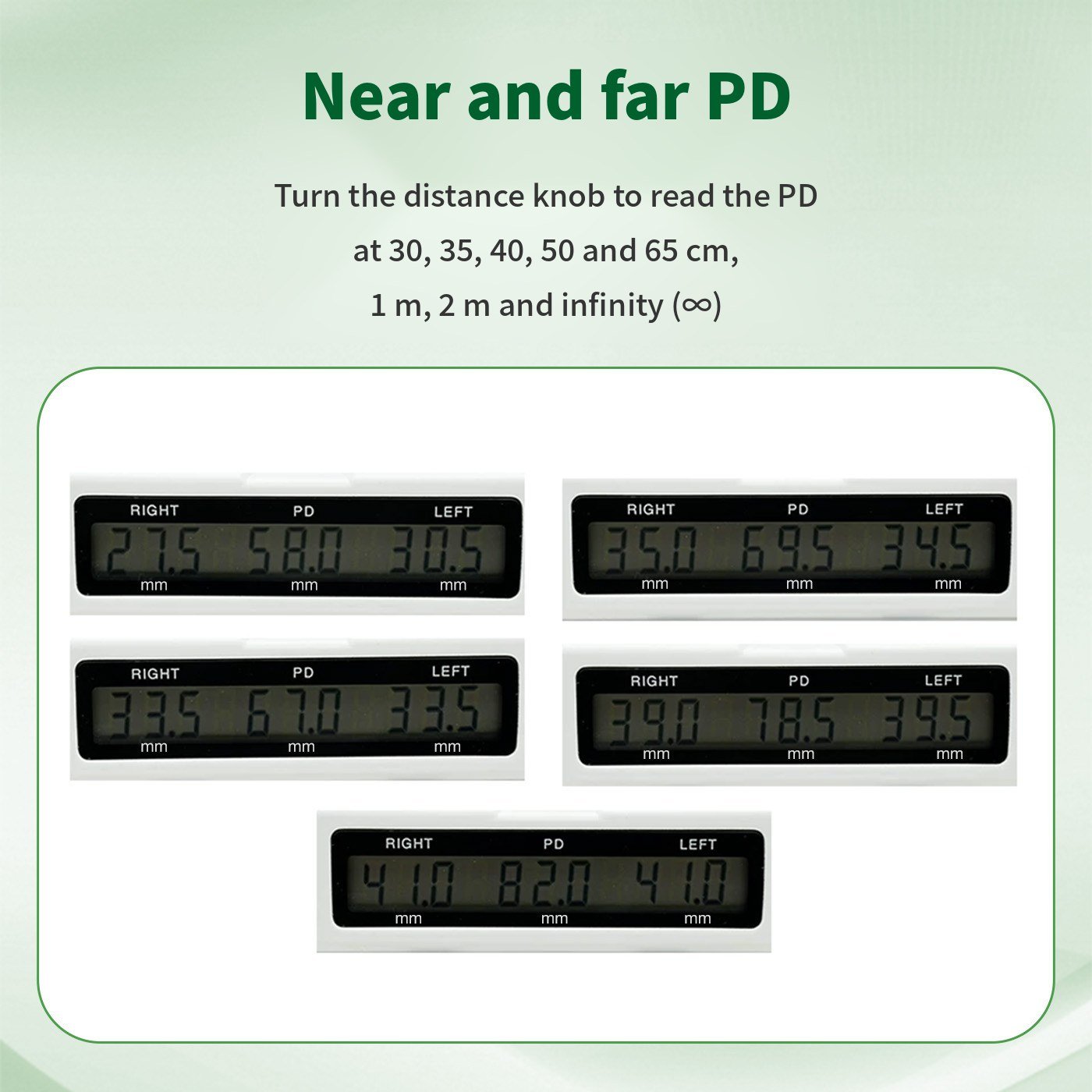
Eight fixation distances
Turn the distance knob to read the PD at 30, 35, 40, 50 or 65 cm, 1 m, 2 m or infinity.
CP-32A1 in figures
Published specifications. Anything not listed here is confirmed in writing on your quotation, never estimated.
The CP-32 series comes in four body and battery versions with the same measuring functions.
CP-32A1
- Binocular PD
- 45–82 mm
- Monocular PD
- 22.5–41 mm
- Visual error
- < 0.5 mm
- Fixation distances
- 30, 35, 40, 50, 65 cm; 1 m, 2 m, ∞
- Display
- LCD: right, total and left PD in mm
- Controls
- Power key, PD function key, right and left eye sliders, distance knob
- Light source
- LED
- Power
- 2 × AA batteries, DC 3 V
- Dimensions
- 220 × 150 × 50 mm
- Packaging
- 250 × 220 × 100 mm
- Gross weight
- 1 kg
Versions
| Model | Difference |
|---|---|
| CP-32A1 | 2 × AA, DC 3 V, 220 × 150 × 50 mm, rotary knob |
| CP-32B1 | 2 × AA, DC 3 V, 220 × 150 × 50 mm, badge front |
| CP-32AT | 1 × AA, DC 1.5 V, 220 × 160 × 55 mm, rotary knob |
| CP-32BT | 1 × AA, DC 1.5 V, 220 × 160 × 55 mm, badge front |
Measuring PD accurately
How it works
A corneal-reflection pupilometer shines a light along the operator’s line of sight. The customer looks into the instrument, and the operator lines up a hairline with the small reflection on each cornea. That reflex sits closer to where the line of sight crosses the cornea than the pupil center does, typically about 1 mm nasal to it.
Monocular PDs matter because faces are rarely symmetrical. For progressives, each 1 mm of monocular PD error narrows the reading area by about 2 mm, so progressives, strong prescriptions and aspheric lenses should always be ordered with monocular values.
Near PD is shorter than distance PD. For a 70 mm distance PD, the near PD falls somewhere around 63–65.5 mm depending on the working distance, which is why the near/far setting is there.
Check before you order
- Binocular and monocular ranges (45–82 mm and 22.5–41 mm here).
- Near and far fixation settings: eight distances from 30 cm to infinity on the CP-32A1.
- Stated accuracy (visual error under 0.5 mm).
- Battery type: two AA (CP-32A1/B1) or one AA (CP-32AT/BT).
- A reference to check it against from time to time.
Good practice
- Check the instrument against a known reference.
- Seat the forehead rest evenly on the customer’s face.
- Turn the distance knob: ∞ for distance PD, or the customer’s working distance (30–65 cm) for near PD.
- Line up the hairline on each corneal reflex; use the occluder for monocular readings.
- Take each reading at least twice, and compare it with the facial asymmetry you can see.
- Watch for head rotation and parallax, which shift readings.
Care and maintenance
- Keep the viewing optics clean.
- Replace batteries when the display dims; take them out if the unit will be stored.
- Check the readings periodically against a known reference, especially at very small and very large PDs.
Background sources: Meet your pupilometer (20/20 Magazine) · Monocular PDs (20/20 Magazine) · Obstfeld & Chou, Ophthalmic and Physiological Optics 1998
Often ordered with the CP-32A1
CP-32A1 questions
Is a pupilometer better than a PD ruler?
In a 2012 study an examiner’s PD ruler differed from a pupilometer by about 0.6 mm on average, while self-measurement and an early phone app were far less repeatable. A pupilometer also gives monocular and near readings directly.
Why measure monocular PD?
Faces are asymmetric. Progressives and strong prescriptions need each optical center placed for its own eye.
How do I get the near PD?
Turn the distance knob to the customer’s working distance (30, 35, 40, 50 or 65 cm) and measure. You can also calculate it from the distance PD, the working distance and the vertex distance.
What is the difference between the CP-32A1, B1, AT and BT?
They measure the same ranges. The A and B versions differ in the front panel; the “1” versions run on two AA batteries and the “T” versions on one.