
Six finishing machines
One machine for each step after the edger, plus the blocker that comes before it.
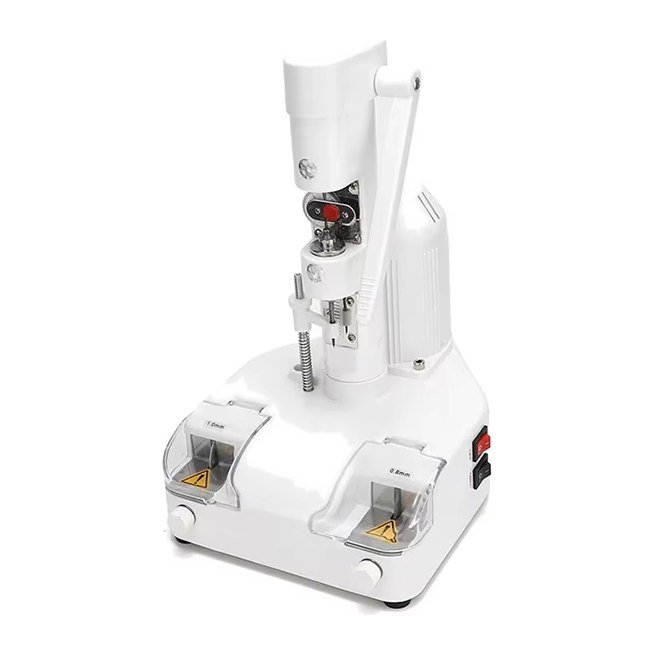
CP-24A
Drilling and slotting for rimless, with speed control.- Function
- Drill + slot
- Speed
- Adjustable
- Size
- 180 × 225 × 300 mm
- Net weight
- 2.37 kg
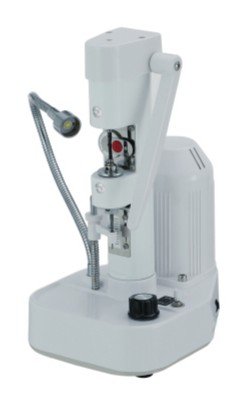
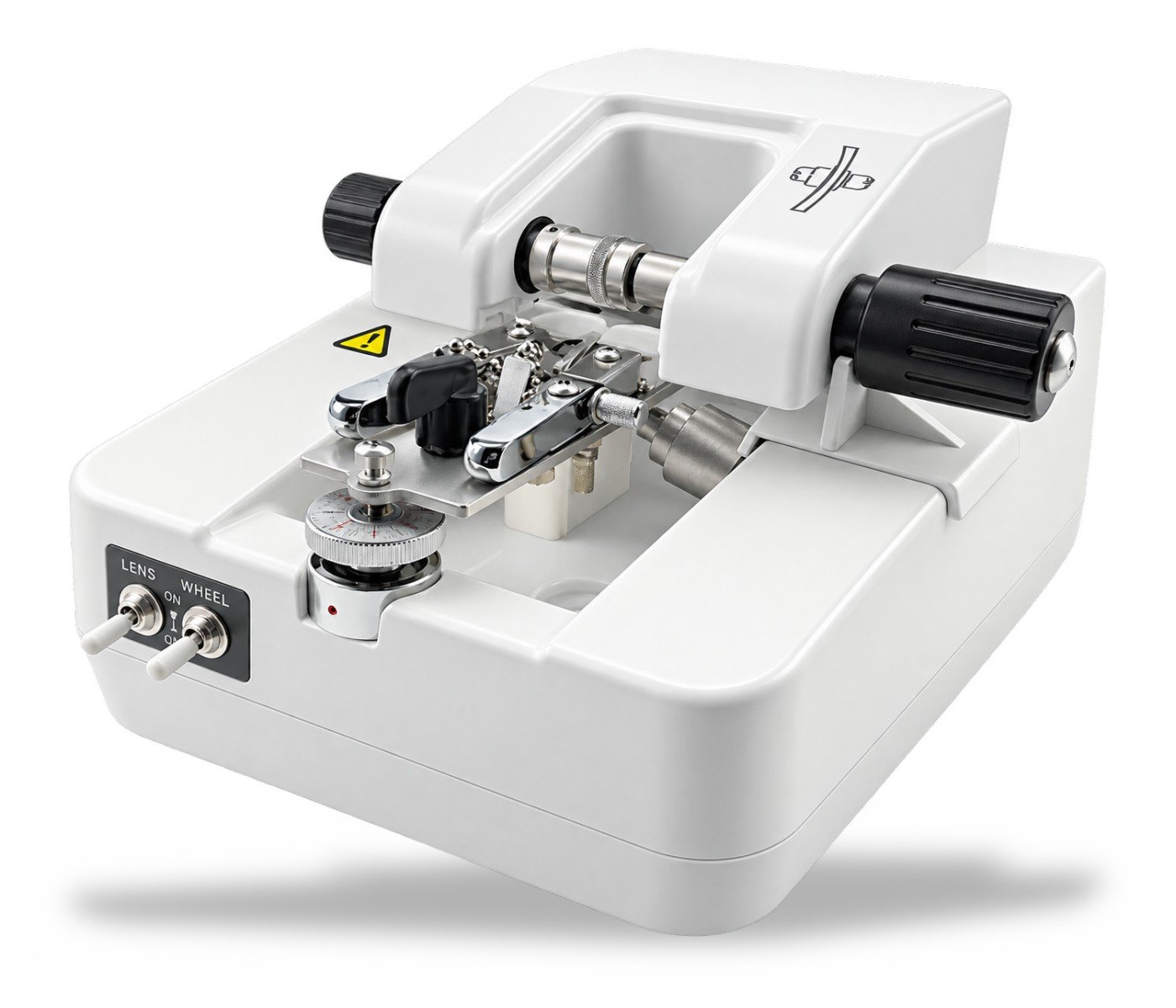
CP-3-800
Lens groover for semi-rimless, 0.6 mm groove.- Groove
- 0.6 mm wide
- Depth
- 0–7 settings
- Time
- approx. 30 s
- Lens diameter
- 28–60 mm
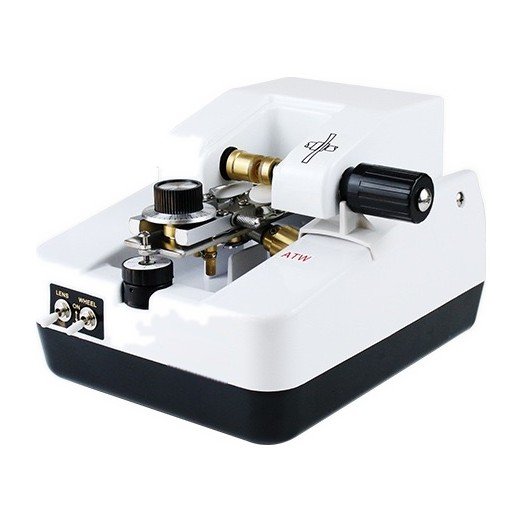
LY-11ATW
Thins the inside edge of full-rim and rimless lenses.- Frames
- Full-rim, rimless
- Cutter
- Tungsten steel, 6,000 rpm
- Power
- 80 W
- Weight
- 2.6 kg
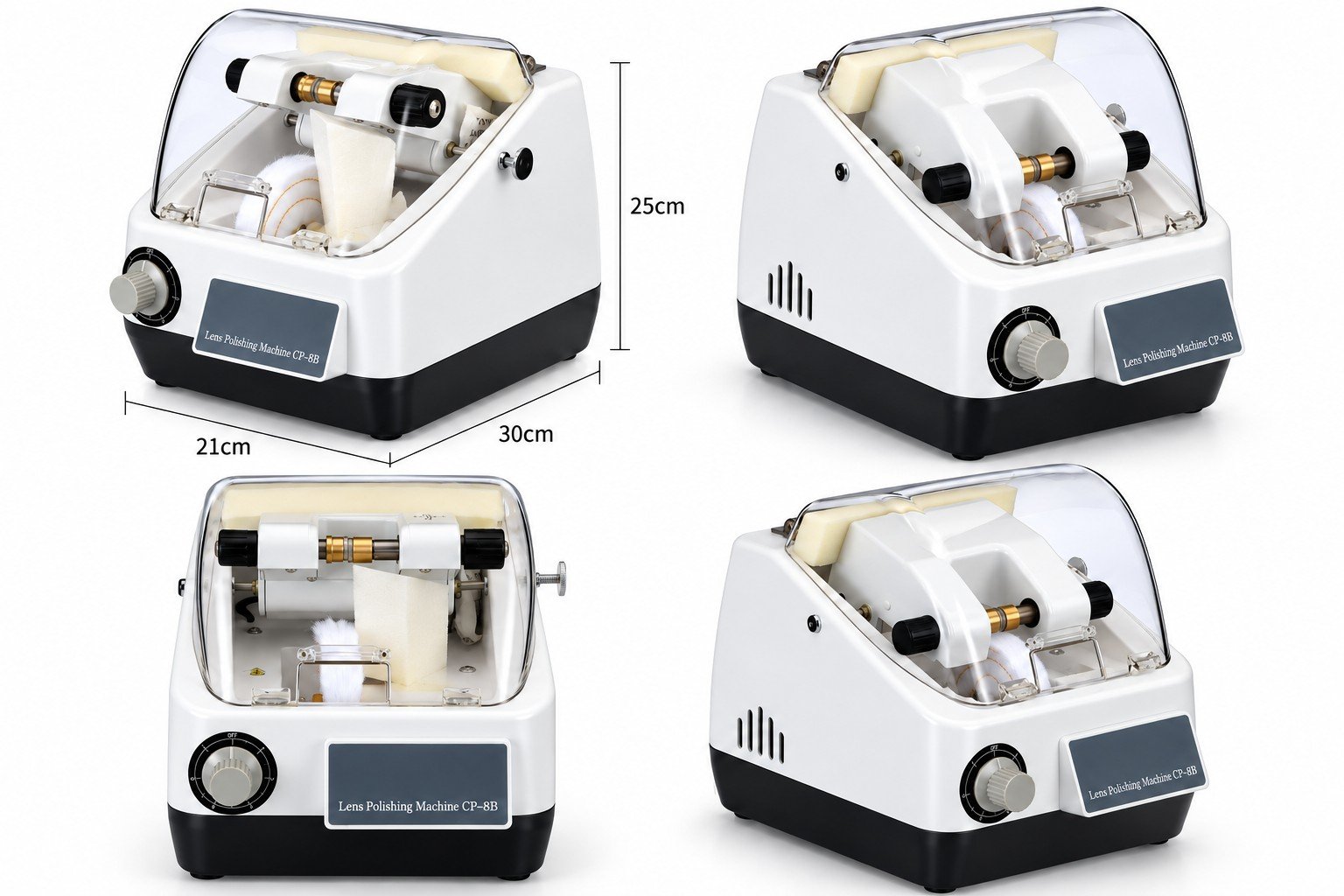
CP-8B
Automatic edge polisher, 1–5 minute timer.- Timer
- 1–5 min
- Wheel
- max. Ø115 mm
- Power
- 80 W
- Net weight
- 4.5 kg
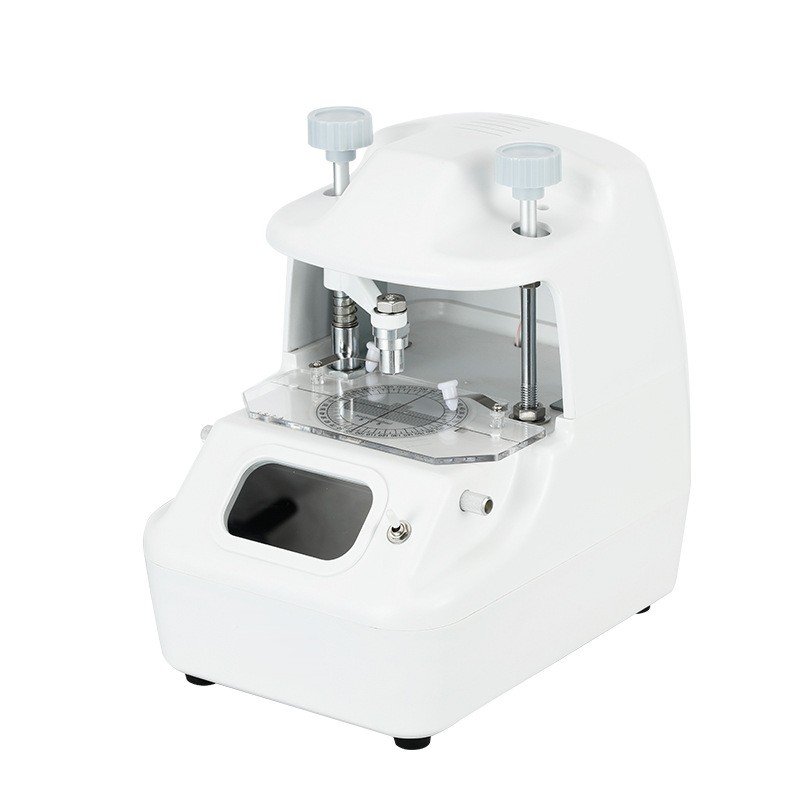
CP-5DT
LED centering and blocking, parallax-free screen, 2 cup heads.- Light
- LED
- Power
- 3 W
- Net weight
- 2.3 kg
- Footprint
- 170 × 240 mm
Which machine for which frame
The frame decides the edge. Pick the row that matches the frames you sell most.
| Frame | Edge it needs | Machines |
|---|---|---|
| Full-rim | Bevel (V) edge, sized to the eyewire | CP-5DT to block · edger · LY-11ATW for thick edges · CP-8B to polish (optional) |
| Semi-rimless (nylon cord) | Flat edge with a 0.6 mm groove | CP-5DT · edger · CP-3-800 to groove · CP-8B to polish |
| Rimless (drill mount) | Flat polished edge, holes or notches | CP-5DT · edger · CP-24A or CP-2A to drill · CP-8B to polish |
Getting finishing right
Rimless drill mounts
Trivex is the first choice for drill mounts and polycarbonate the second, because they resist cracking at the holes. Chamfer each hole on both sides, fit bushings so metal never presses on the lens, and keep acetone and thread-lock away from the mount.
Semi-rimless grooves
Nylon cord is typically 0.5–0.7 mm thick. A groove about 0.6 mm wide with roughly 0.9 mm of wall on each side, on an edge about 2.2–2.5 mm thick, holds well without chipping. On thick minus lenses, move the groove toward the front.
Thick full-rim lenses
Bevelling and polishing the back edge makes a strong minus lens look thinner in the frame. Move the bevel apex back a little so less edge shows behind the frame, then polish the edge clear.
Polishing
- Polish exposed edges: rimless, semi-rimless and thick high-minus lenses.
- Keep polishing compound off coated surfaces.
- Polish polycarbonate edges before fitting metal frames to help prevent cracks.
Background sources: Eight tips for processing rimless or semi-rimless eyewear (Eyecare Business) · A simpler view of rimless eyewear (Review of Ophthalmology) · Lens makeover (20/20 Magazine)
Lens finishing questions
What do I need for rimless frames?
A drill (CP-2A) or a drilling and slotting machine (CP-24A), plus a polisher for the flat edge and rimless pliers for mounting.
What do I need for semi-rimless frames?
A groover such as the CP-3-800, nylon cord in the right thickness, and ideally a polisher for the exposed edge.
Is edge polishing necessary?
Not on every lens. Polish exposed edges and thick high-minus edges; on full-rim frames it is optional.
Why block a lens at all?
The block fixes the lens at the right decentration and axis so the edger cuts the shape in the right place. An error of 1 mm on a 4 D lens creates 0.4 prism diopters.