
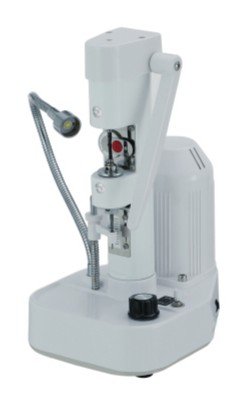
CP-2A Lens drill for rimless eyeglasses
A compact, speed-adjustable lens drill on an aluminum seat post, for drilling the holes in rimless (drill-mount) lenses. It is shown with a flexible LED lamp over the work area.
Delivery, packing and documents
What the CP-2A does
Rimless drilling
Drills the holes for the screws or bushings of drill-mount frames.
Adjustable speed
Slow the bit down for polycarbonate and speed it up for other materials.
Aluminum seat post
The drilling head is carried on an aluminum post.
LED lamp
Shown with a flexible LED lamp to light the drilling point.
Compact
Ships in an inner box of 235 × 195 × 320 mm, 3 kg net.
Pairs with a slotting machine
For mounts that clamp into edge notches, add the CP-24A, which drills and slots.
CP-2A in figures
Published specifications. Anything not listed here is confirmed in writing on your quotation, never estimated.
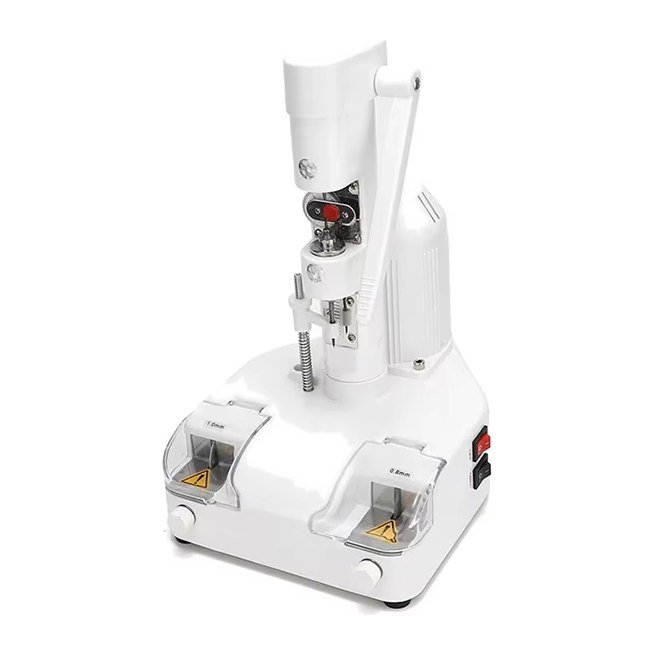
The CP-2B shares this parameter table and is shown with a flat lens support platform instead of the lamp.
CP-2A
- Voltage
- AC 220 V / 50 Hz, 110 V / 60 Hz
- Power
- 25 W
- Net weight
- 3 kg
- Inner box
- 235 × 195 × 320 mm
- Speed
- Adjustable
Versions
| Model | Difference |
|---|---|
| CP-2A | Speed-adjustable, aluminum seat post, flexible LED lamp |
| CP-2B | Speed-adjustable, aluminum seat post, flat lens support platform |
Good rimless drilling practice
How it works
A lens drill makes the holes a rimless (drill-mount) frame is screwed through. The simplest method copies the holes from the frame’s demo lens: lay the demo lens on the edged lens, mark the positions and drill.
Speed control is the feature to look for. Polycarbonate softens with heat, so trade guides advise drilling it at about half speed, in shallow passes with pauses to cool, and with light pressure. Harder materials can run faster.
Most drilled-lens failures start at the hole. Chamfering both sides of each hole, fitting bushings or washers so metal never presses on the lens, and keeping acetone and thread-lock away from the mount prevent the majority of star cracks.
Check before you order
- Speed control (the CP-2A has it) for polycarbonate work.
- A light over the drilling point, or a lens support platform (CP-2B).
- A supply of sharp bits in the sizes your frames use.
- Whether you also need slots for notch-type mounts (then consider the CP-24A).
Good practice
- Edge the lens to the demo lens shape and check the fit first.
- Mark the hole positions from the demo lens.
- Drill with a sharp bit at the right speed for the material.
- Chamfer both sides of every hole.
- Fit bushings or washers, and trim compression sleeves with a sleeve trimmer rather than cutting pliers.
- Inspect for micro-cracks before the glasses leave the bench.
Care and maintenance
- Replace bits when dull; inspect them under magnification.
- Keep the chuck and seat post clean of lens dust.
- Store bits dry and sorted by size.
Background sources: Eight tips for processing rimless or semi-rimless eyewear (Eyecare Business) · The art and science of rimless eyewear, part 1 (TTUHSC, ABO-NCLE course) · Edging poly: a troubleshooting guide (Eyecare Business)
Often ordered with the CP-2A
CP-2A questions
What is the difference between the CP-2A and CP-2B?
They share one parameter table. The CP-2A is shown with a flexible LED lamp; the CP-2B has a flat lens support platform instead.
Can the CP-2A cut notches?
It is listed as a drilling apparatus. For slots and notches, use the CP-24A drilling and slotting machine.
How fast should I drill polycarbonate?
Trade guides recommend about half speed, shallow passes of roughly 0.5 mm with pauses to cool, and light pressure.
Which tools do I need for rimless mounting?
Besides the drill: rimless pliers, a sleeve trimmer and a set of optical screwdrivers. See the rimless plier kits on our Tools & Spare Parts page.