
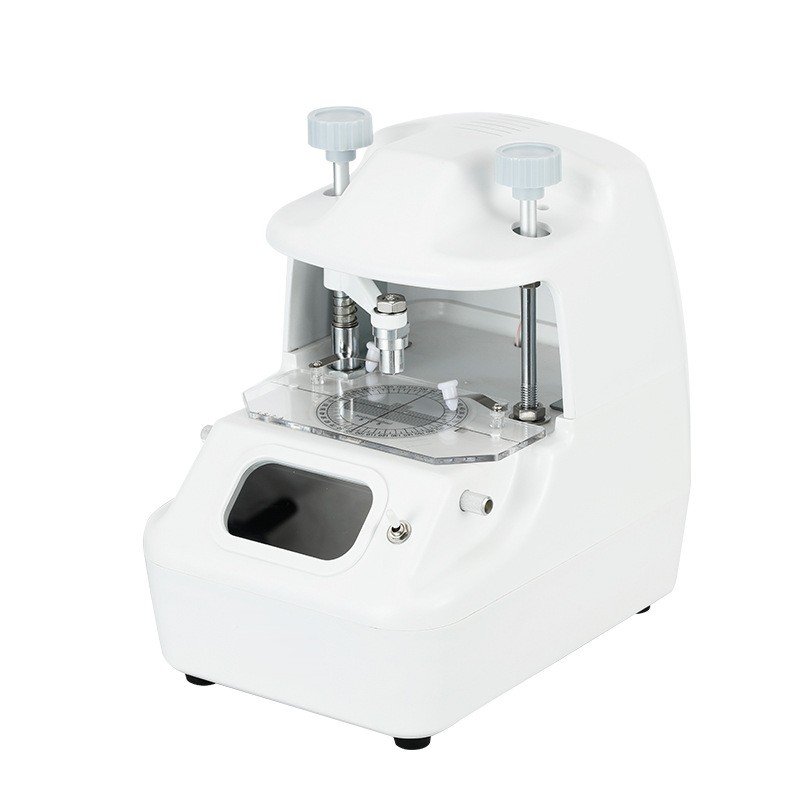
CP-5DT Lens centering and blocking machine
A lens centering device with LED illumination and a parallax-free viewing screen. Lay the lens out on the clear scale table, set the decentration, and press the suction cup onto the lens at the right point before it goes into the edger. Two interchangeable suction-cup heads fit the cups used by most edgers, and it handles bifocal lenses.
Delivery, packing and documents
What the CP-5DT does
Layout and decentration
Position the lens by its optical center or segment on the scale table, offset so the center lands in front of the pupil once cut.
Blocking
Press the suction cup onto the lens at that point, so the edger cuts the shape in the right place and at the right axis.
Parallax-free screen
Check the layout on a viewing screen that shows the scale without parallax or distortion.
LED illumination
Energy-efficient LED lighting for precise positioning.
Two suction-cup heads
Small head for bar-type cups (standard) and large head for slotted cups; they fit the cups of most edgers.
Single vision and bifocal
Lays out single-vision and bifocal lenses.
A closer look at the CP-5DT
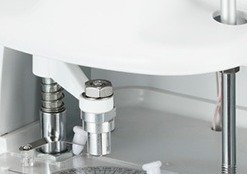
LED illumination
LED lighting over the layout area makes marks easy to see for precise positioning, and uses little energy.
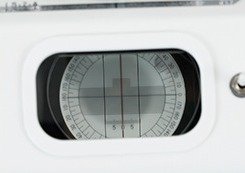
Parallax-free screen
The viewing screen shows the lens on the scale without parallax or distortion, for a more accurate layout.
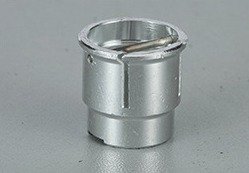
Two suction-cup heads
A small head for bar-type cups is fitted as standard; a large head takes slotted cups. Together they fit the cups used by most edgers.
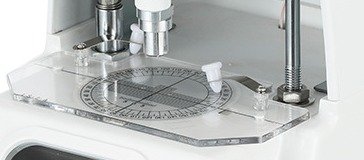
Clear layout table
A transparent table with an angle scale for setting axis and decentration before blocking.
CP-5DT in figures
Published specifications. Anything not listed here is confirmed in writing on your quotation, never estimated.
The CP-5D shares this specification.
CP-5DT
- Illumination
- LED
- Viewing screen
- Parallax-free
- Suction-cup heads
- Small head for bar-type cups (standard); large head for slotted cups
- Lenses
- Single vision, bifocal
- Voltage
- AC 220 V / 50 Hz (110 V / 60 Hz made to order)
- Power
- 3 W
- Dimensions (W × D × H)
- 160 × 240 × 260 mm
- Net weight
- 2.3 kg
- Package dimensions
- 295 × 210 × 300 mm
- Package weight
- 2.88 kg
Centering and blocking, step by step
How it works
Before edging, the lens has to be positioned so its optical center (single vision) or segment (bifocals) will sit in front of the pupil once the lens is cut to the frame shape. That is layout and decentration. Blocking then attaches a suction cup or block at that position, so the edger cuts the shape in the right place and at the right axis.
For single vision, decentration per eye is the frame PD minus the patient PD, divided by two. With a 72 mm frame PD and a 64 mm patient PD, each lens moves 4 mm in. With monocular PDs, use half the frame PD minus each monocular PD. Progressives are laid out from the fitting cross using monocular PD and fitting height.
Accuracy matters because a decentered lens creates prism. By Prentice’s rule, prism equals decentration in centimeters times lens power, so a 1 mm error on a 4 D lens produces 0.4 prism diopters. A parallax-free screen helps here: you read the scale straight on, not at an angle.
Check before you order
- Suction-cup fit with your edger’s chuck; this is the most common mismatch. The CP-5DT has two heads for bar-type and slotted cups.
- A readable, evenly lit scale and a viewing screen free of parallax.
- How you will lay out bifocals and progressives.
- Voltage: 220 V as standard; order 110 V versions in advance.
- Spare cups and pads for coated lenses.
Good practice
- Verify the lens in the lensmeter and mark the optical center.
- Calculate the decentration for each eye.
- Place the lens on the scale table at that offset, level to the 180° line, and check it on the viewing screen.
- Fit the right suction-cup head for your edger’s cups.
- Apply a clean, dry cup to the front surface, then edge and check the fit before removing it.
Care and maintenance
- Keep the layout table and viewing screen clean.
- Check the scale’s zero against a known lens from time to time.
- Replace worn cups; they are consumables.
- Clean lenses with isopropyl alcohol before blocking, especially polycarbonate; avoid acetone.
Background sources: Layout basics for single vision edging (OpticianWorks) · Blockers (OpticianWorks) · Adjusting optical centers (20/20 Magazine)
Often ordered with the CP-5DT
CP-5DT questions
What does a centering device actually set?
Horizontal decentration, vertical position (optical center or segment height) and axis, so that the finished lens induces no unwanted prism.
Which suction-cup head does it come with?
The small head for bar-type cups is fitted as standard. A large head for slotted cups is also available, and together they fit the cups used by most edgers.
How accurate does centering need to be?
In the US, ANSI Z80.1 limits unwanted prism at the prism reference point to about 0.33 prism diopters and places the progressive fitting cross within ±1.0 mm. Your local standard may differ.
Does it work on 110 V?
The standard version is AC 220 V / 50 Hz. A 110 V / 60 Hz version is made to order, so tell us your voltage when you ask for a quotation.
Do you supply cups for my edger?
Our Tools & Spare Parts list includes suction cups for Nidek, Briot, Weco, Topcon and Takubo edgers, plus blocking pads in several sizes.