
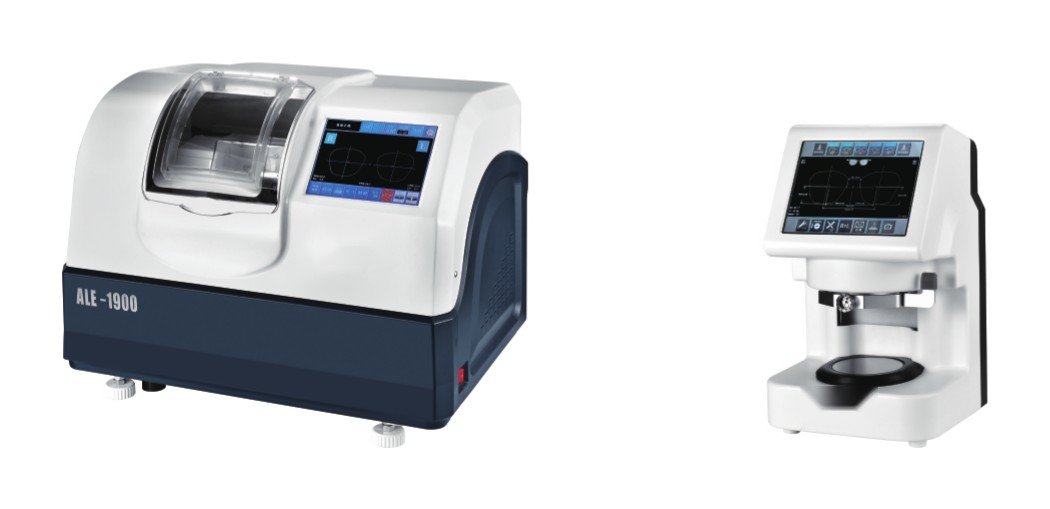
ALE-1900 Automatic lens edger with scanner
An automatic lens edger that works with a separate scanning unit. The scanner images the lens, recognizes the axis and guides centering on its 8-inch screen. The edger then grinds a sharp (bevel) edge or a flat edge and can polish both, driven by a servo motor with multi-stage clamping pressure.
Delivery, packing and documents
What the ALE-1900 does
Scan and center in one unit
Integrated optical scanning and centering. The scanner images the lens quickly and guides centering in real time on its screen.
Automatic axis recognition
The scanner recognizes the lens axis automatically as part of the scan.
Bevel and flat edges
Sharp edge (bevel), polished sharp edge and polished flat edge. A mini sharp edge is also listed.
Selectable bevel position
The sharp-edge position is selectable, so you can move the bevel forward or back to suit the lens and frame.
Multi-stage clamping
Clamping pressure is regulated in several stages, and a universal swivel chuck holds the lens. The grinding disc stays securely in place.
Servo-driven wheel
A servo motor drives the Φ100 mm grinding wheel, at about 5,000 rpm for rough grinding.
ALE-1900 in figures
Published specifications. Anything not listed here is confirmed in writing on your quotation, never estimated.
The wheel configuration is matched to your lens materials. Tell us which materials you edge and we confirm it on the quotation.
Edger
- Grinding diameter range
- Φ20–80 mm
- Grinding wheel
- Φ100 mm
- Rough grinding speed
- approx. 5,000 rpm
- Pointed edge mode
- Forced sharp edge
- Wheel motor
- Servo motor
- Clamping force
- Multi-stage pressure regulation
- Voltage
- AC 220 V / 50 Hz, 110 V / 60 Hz
- Power
- 750 W
- Weight
- 40 kg
- Dimensions
- 600 × 460 × 470 mm
- Main unit carton
- 733 × 585 × 615 mm, 45 kg gross
- Accessory box
- 435 × 332 × 285 mm, 3 kg gross
Scanner
- Screen
- 8" LCD
- Voltage
- AC 220 V / 50 Hz, 110 V / 60 Hz
- Power
- 80 W
- Weight
- 9 kg
- Dimensions
- 240 × 220 × 360 mm
- Carton
- 520 × 340 × 357 mm, 9 kg gross
The ALE-1900 in a finishing lab
How it works
An edging system does three jobs. It reads the shape the lens must be cut to, positions the lens so the optical center lands in front of the pupil (centering and blocking), and grinds the lens to that shape. On the ALE-1900 the first two jobs happen on the scanner unit, which images the lens and shows the centering on screen; the edger does the grinding.
Grinding normally runs as a rough cut followed by a finishing pass that forms the edge profile: a bevel (sharp edge) for full-rim frames or a flat edge for rimless and semi-rimless work. A polishing pass then turns the frosted edge clear. Clamping pressure matters most on slippery coated lenses, which can rotate on the block and come out off-axis; the ALE-1900 lets you step the pressure.
The ALE-1900 does not groove or drill. Shops that fit semi-rimless and rimless frames add a groover and a drilling machine to the bench.
Check before you order
- Lens materials you edge every week (CR-39, polycarbonate, high-index, glass), so we can confirm the wheel set.
- Edge profiles you need: bevel, mini bevel, flat and polish are listed; plan a separate groover and drill for semi-rimless and rimless frames.
- Lens size: the grinding diameter range is Φ20–80 mm.
- Bench space for two units: 600 × 460 mm for the edger plus 240 × 220 mm for the scanner, with room for water supply and drainage.
- Power: 750 W for the edger and 80 W for the scanner. Trade guides recommend a dedicated circuit for an edger and no extension cords.
- Consumables to order with it: blocking pads and suction cups that match the chuck, plus spare wheels if you edge glass.
Good practice
- Scan the lens or demo lens and check the shape on screen.
- Verify the lens power in the lensmeter and mark the optical center.
- Center and block the lens at the decentration the prescription needs.
- Choose the lens material, edge profile and bevel position.
- Edge, then check the size against the frame before you remove the block.
- Polish, safety-bevel if needed, mount, and do a final check against your tolerance standard (ANSI Z80.1 in the US).
Care and maintenance
- Rinse the grinding chamber daily and change the water regularly. Published intervals run from 15 to 100 jobs depending on tank size, materials and filtration, so follow the machine manual.
- Clean poly and high-index swarf out of the chamber and off the clamp pads between jobs.
- Vacuum dust rather than blowing it into the mechanism, and keep sensors clean.
- Replace dull wheels: a worn roughing wheel crushes rather than cuts, which raises heat and causes edge chips.
Background sources: Edger basics (20/20 Magazine) · Eliminating lens edge fractures (The Optical Journal) · ANSI Z80.1 quick reference (The Vision Council)
Often ordered with the ALE-1900
ALE-1900 questions
Does the ALE-1900 groove or drill lenses?
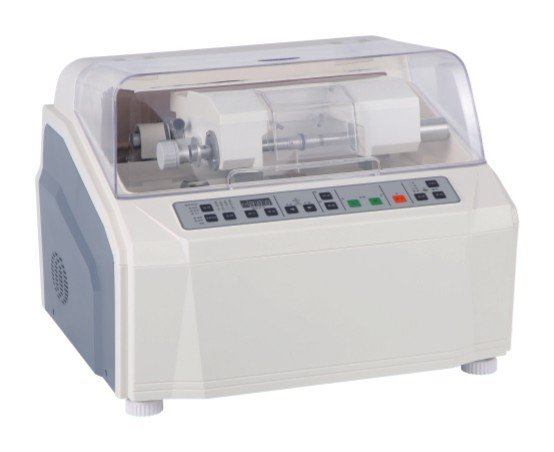
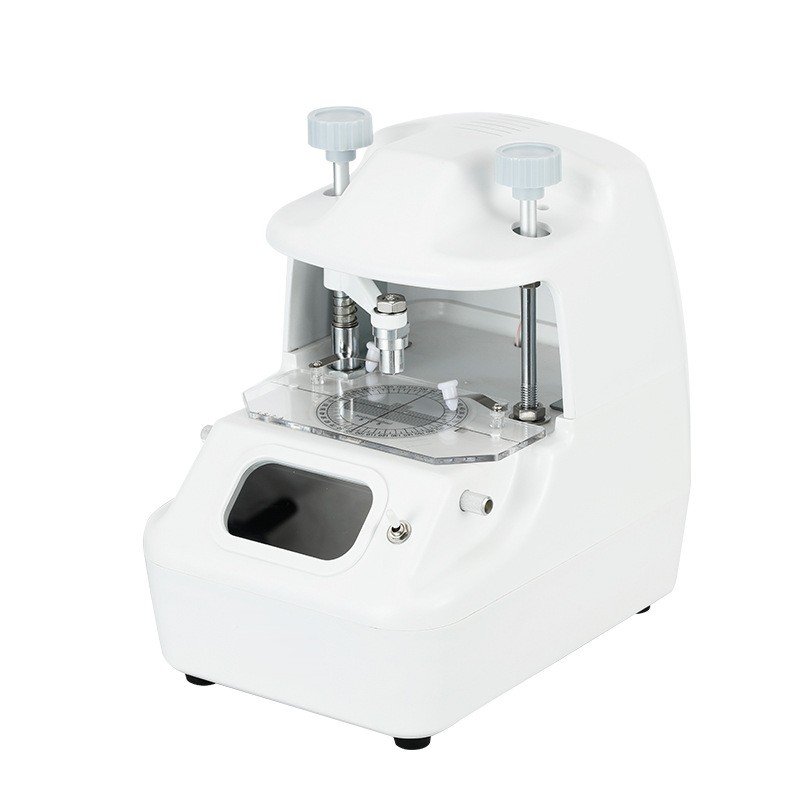
It edges sharp (bevel), polished sharp and polished flat profiles. It does not groove or drill, so shops that fit semi-rimless and rimless frames pair it with the CP-3-800 groover and the CP-24A drilling and slotting machine, or choose the SJG-1000AK, which grooves automatically.
Which lens materials can it edge?
The wheel set is matched to your materials. Tell us what you edge (CR-39, polycarbonate, high-index, glass) and we confirm the wheel configuration on your quotation.
Why do coated lenses sometimes come out off-axis?
Hydrophobic top coats are slippery, so the lens can turn on the block during grinding. Use pads made for coated lenses, keep blocks clean and dry, and step down the clamping pressure as the lens maker recommends.
How much bench space does it need?
The edger measures 600 × 460 × 470 mm (40 kg) and the scanner 240 × 220 × 360 mm (9 kg). Leave working room on both sides and plan the water supply and drain before delivery.