
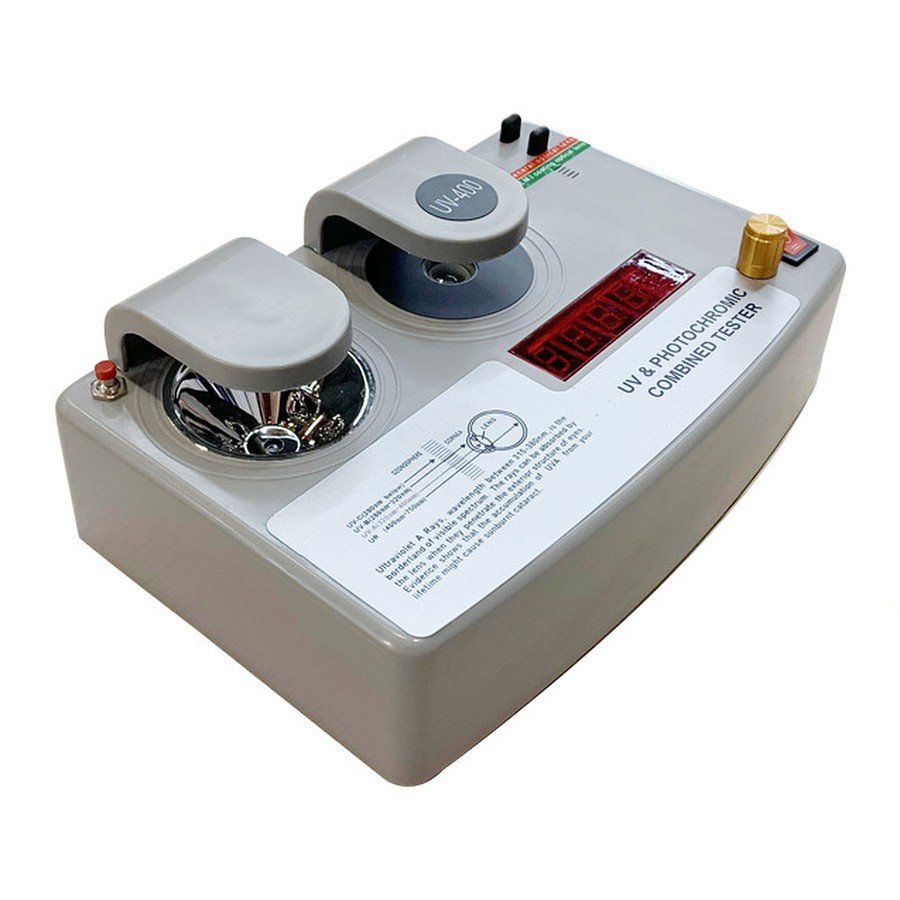
CP-18C UV and photochromic lens tester
A counter tester for UV-blocking and photochromic lenses. Use it to show a customer how a photochromic lens reacts to UV and how a UV-blocking lens compares. Mains powered, 10 W, under 1 kg.
Delivery, packing and documents
What the CP-18C is for
Photochromic demonstration
Show a photochromic lens reacting to UV at the counter, where there is no sunlight.
UV comparison
Show the difference between a UV-blocking lens and one without UV protection.
Counter size
236 × 157 × 57 mm, 0.9 kg; it fits next to the mirror.
Mains powered
Runs on AC 220 V or 110 V at 10 W.
Two test positions
Two covered test positions, one marked UV-400, with a five-digit LED display and indicator lights labelled for general and EMI-coated lenses.
Pairs with the CP-18B
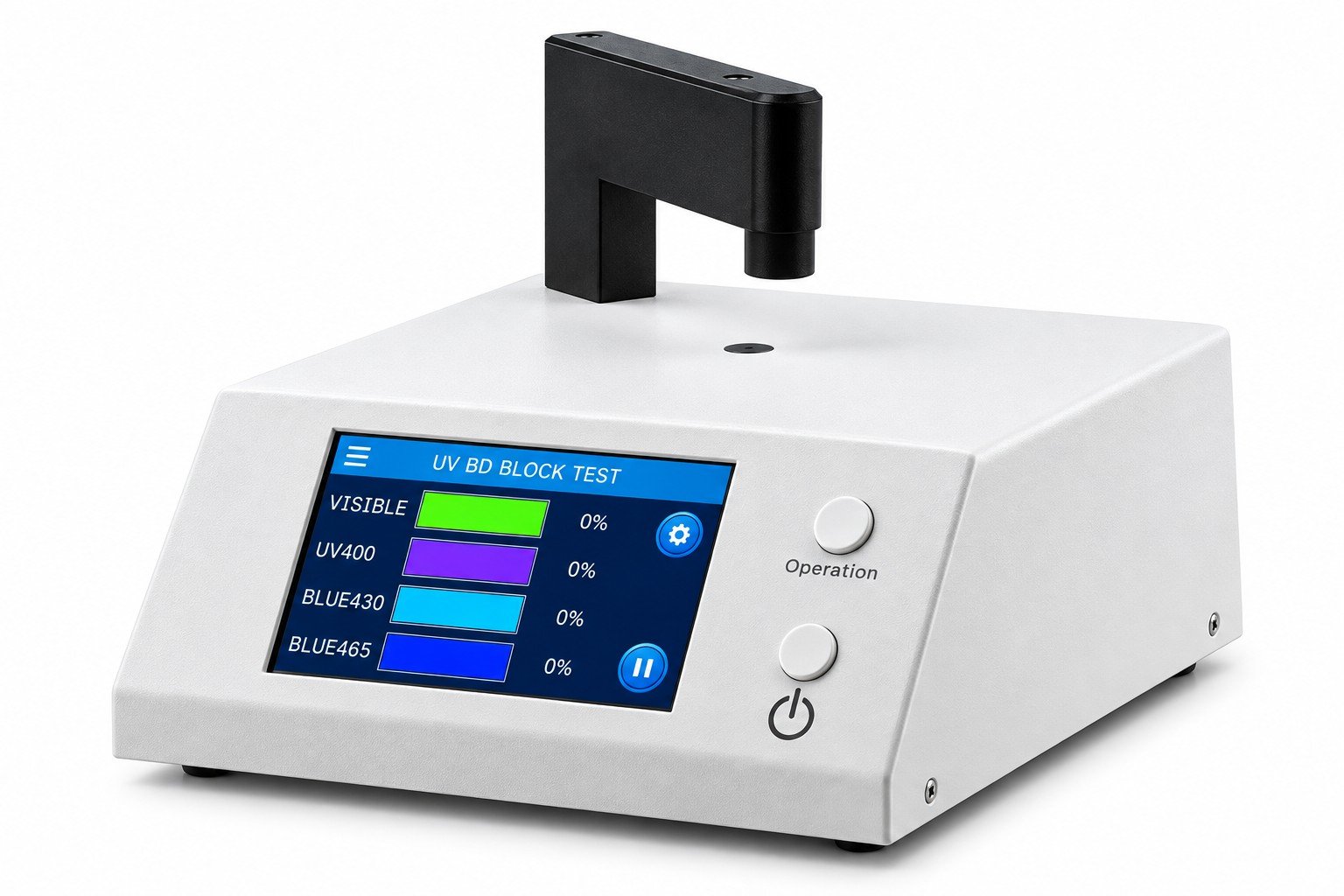
Add the CP-18B when you need documented transmittance figures.
CP-18C in figures
Published specifications. Anything not listed here is confirmed in writing on your quotation, never estimated.
The CP-18C is a demonstrator. For documented transmittance figures, use the CP-18B.
CP-18C
- Power supply
- AC 220 V / 50 Hz, 110 V / 60 Hz
- Power
- 10 W
- Weight
- 0.9 kg
- Dimensions
- 236 × 157 × 57 mm
- Packaging weight
- 1.1 kg
- Packaging dimensions
- 275 × 170 × 102 mm
Demonstrating UV and photochromic lenses
How it works
Photochromic lenses darken in response to UV. Indoors there is almost no UV, so a counter tester with its own UV source is the practical way to show the effect before a customer buys.
Set expectations honestly. How dark a photochromic lens gets depends on UV level, temperature and the lens material: lenses darken more in the cold and less in the heat. Car windshields block most UV, so most photochromics darken only a little in the car. Lens makers specify fade-back times at room temperature (around 23 °C).
A demonstration shows that a lens blocks some UV; it does not prove a UV400 rating. For a number, use a transmittance meter such as the CP-18B, and quote the wavelength it measures at.
Check before you order
- What you want to show: photochromic darkening, UV blocking, or both.
- Whether you also need numbers (then add the CP-18B).
- Counter space and a power socket nearby.
- Voltage for your country.
Good practice
- Keep a photochromic sample lens and a clear lens at the counter.
- Show the clear lens first, then the photochromic lens, so the customer sees the change.
- Explain what affects the result: UV level, temperature and time.
- Mention the windshield effect so the customer is not surprised in the car.
- Let the lens fade back before the next demonstration.
Care and maintenance
- Keep the test surfaces clean.
- Let the unit rest between long demonstration sessions.
- Store sample lenses in a case so they do not scratch.
Background sources: Demonstrating lenses (20/20 Magazine) · College of Optometrists on blue-light filtering lenses (2023)
Often ordered with the CP-18C
CP-18C questions
Does the CP-18C give documented readings?
It is built for demonstrating UV blocking and photochromic darkening. No measuring range or accuracy is specified for it, so for documented transmittance figures use the CP-18B, which reads 400, 430 and 465 nm.
Why do photochromic lenses not darken much in the car?
The windshield blocks most of the UV that activates them.
Why does the lens darken differently from day to day?
Photochromic darkening depends on temperature as well as UV: lenses darken more when cold and less when warm.
Does a UV demonstration prove a lens is UV400?
No. It shows that some UV is blocked. A transmittance meter gives a value at a stated wavelength.