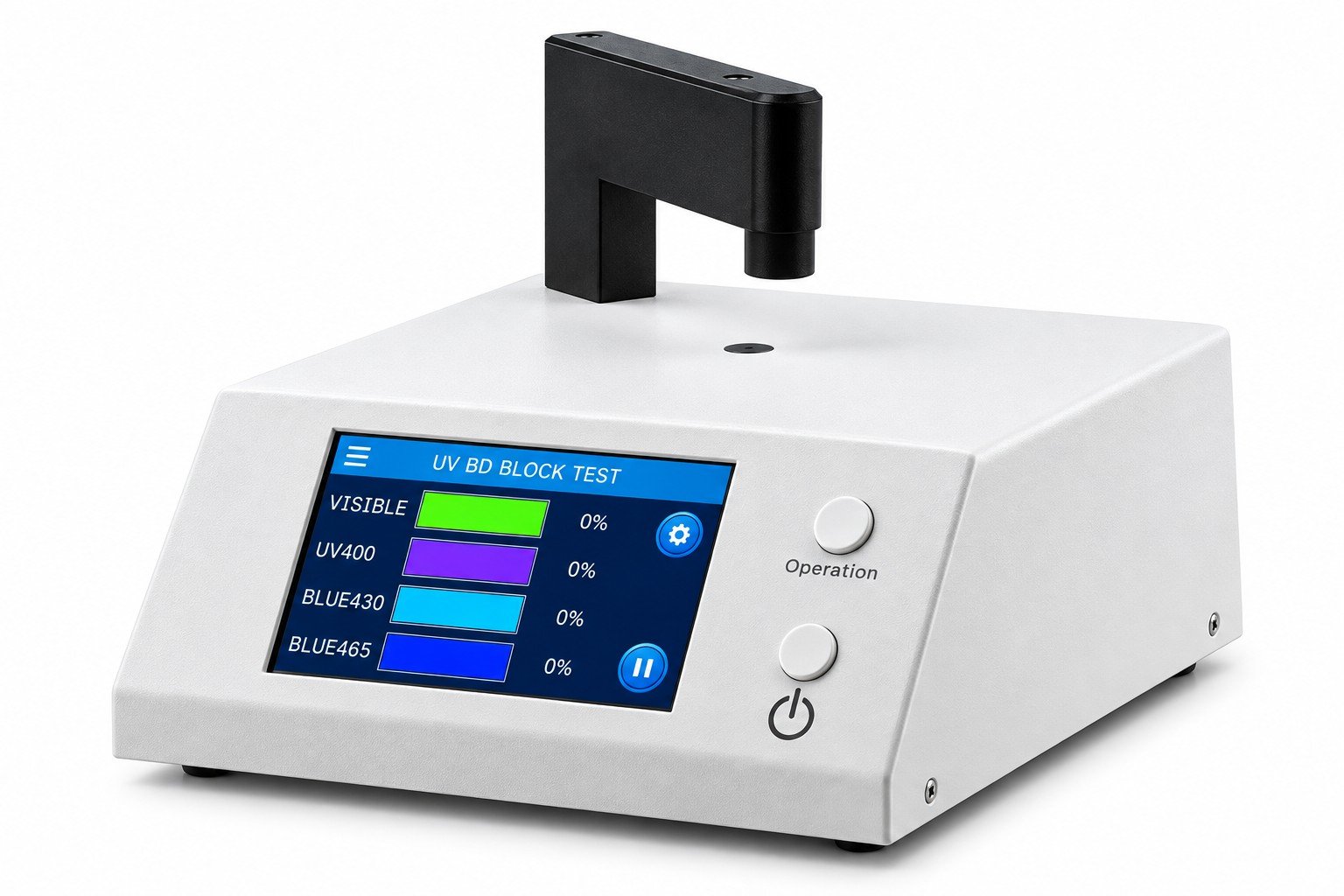
CP-18B Multi-function lens tester for UV, blue and visible light
A counter-top tester that measures how much light a lens transmits at four points: violet at 400 nm, blue at 430 nm and 465 nm, and the full visible spectrum from 380 to 760 nm. Readings show on a 4-inch color screen, so customers see what their lens does.
Delivery, packing and documents
What the CP-18B measures
Four readings at once
Transmittance at 400 nm (violet), 430 nm and 465 nm (blue) and across the visible spectrum.
1% resolution
Readings in 1% steps, accurate to ±2 on colorless, uniform materials between 0 and 90% transmittance.
Small samples
Measures areas down to 1 mm in diameter.
Color screen
A 4.0-inch 480 × 320 color LCD that customers can read across the counter.
Buttons and touch
Operated by touch or by two buttons: Operation opens the function menu, and the second button starts a test, recovers and switches the unit on or off.
Cordless option
An optional built-in lithium battery frees it from the socket.
A closer look at the CP-18B
Controls and readings
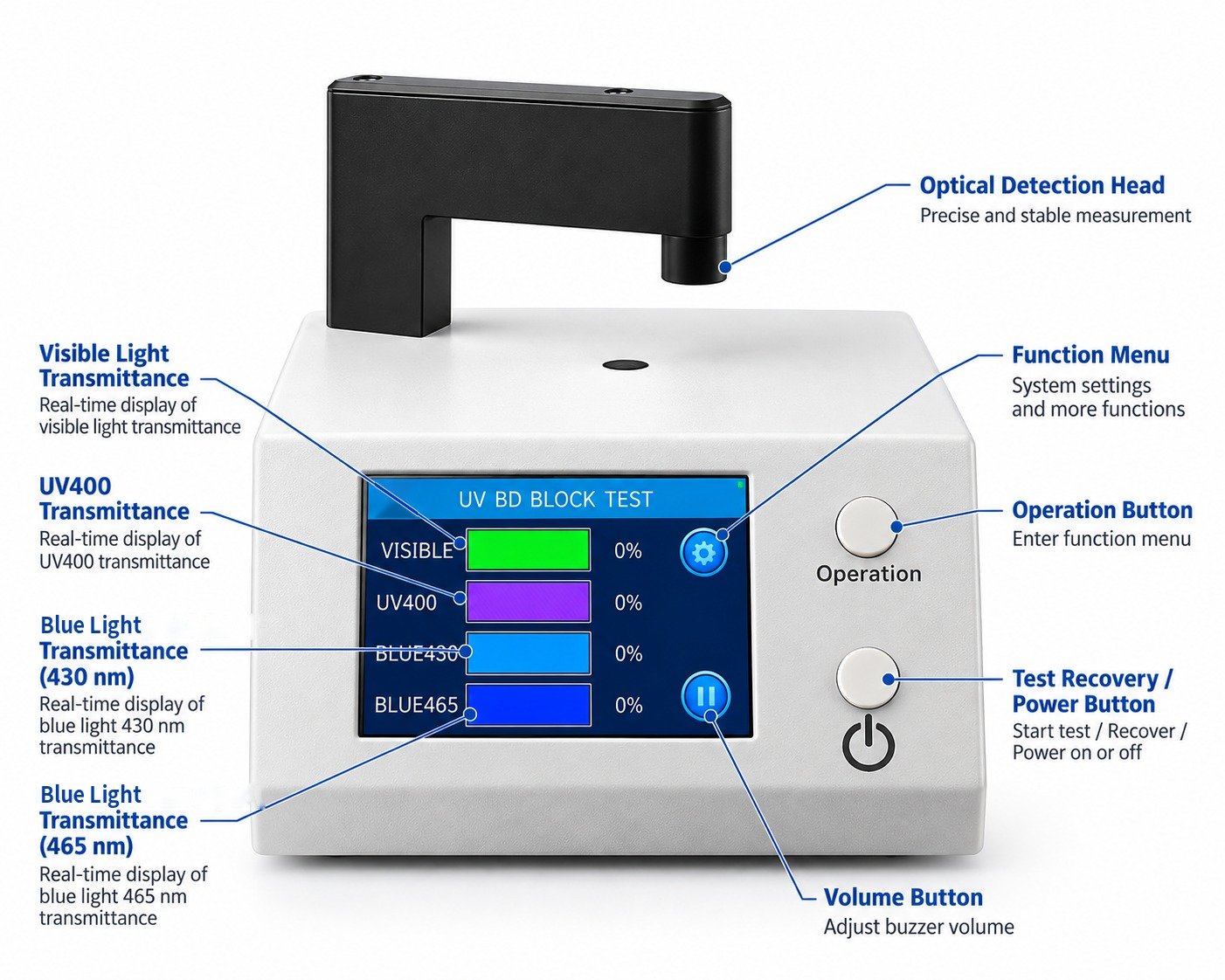
The optical detection head sits over the lens window. The screen shows live transmittance for visible light, UV400, blue 430 nm and blue 465 nm, with on-screen settings and buzzer volume. Operation opens the function menu; the second button starts a test, recovers, and switches the unit on and off.
Counter-top size
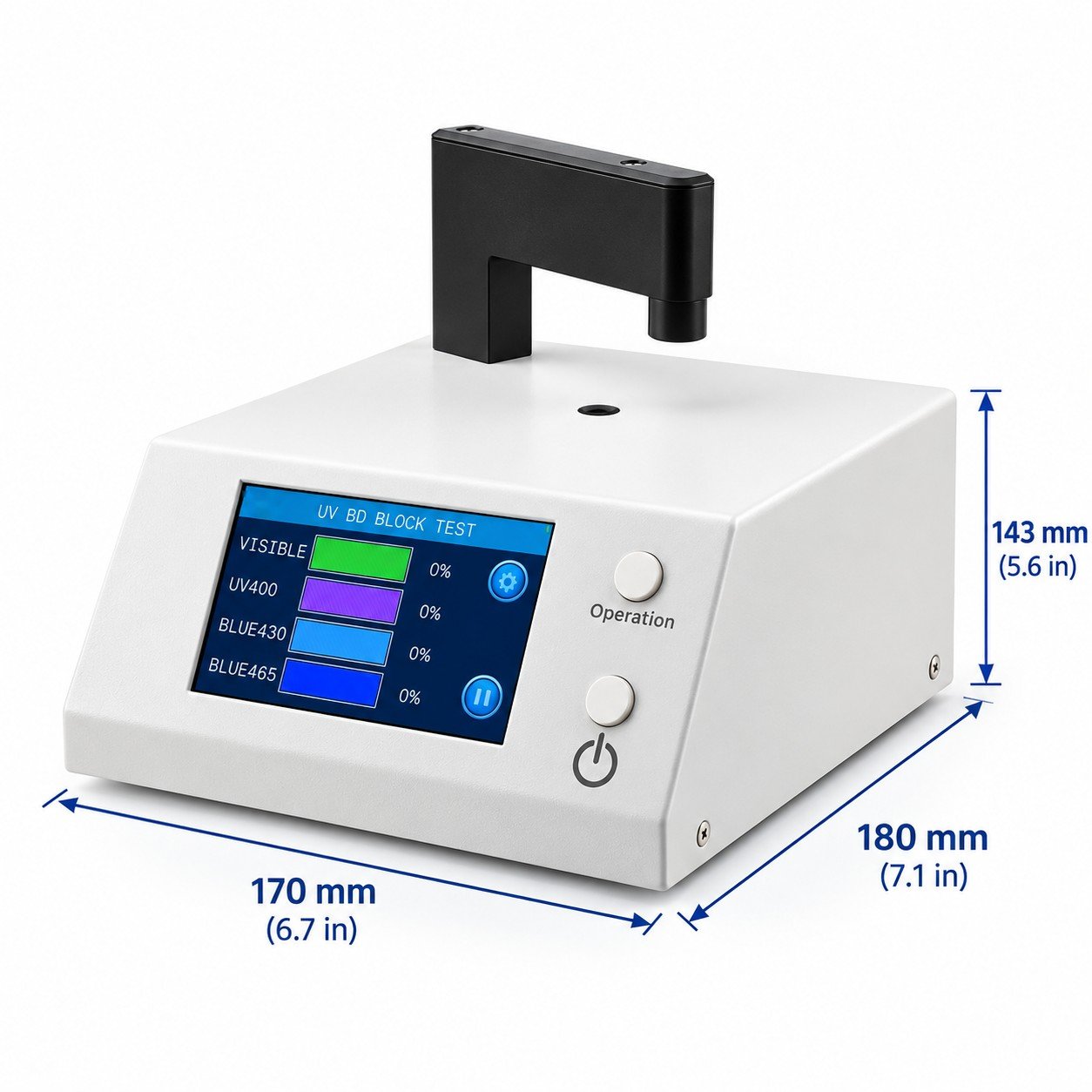
170 × 180 mm on the counter and 143 mm high, about 1.5 kg.
CP-18B in figures
Published specifications. Anything not listed here is confirmed in writing on your quotation, never estimated.
Accuracy is specified for colorless, uniform materials. Readings on tinted, gradient or photochromic lenses are indicative.
CP-18B
- Wavelengths
- Violet 400 nm; blue 430 nm; blue 465 nm; visible 380–760 nm
- Display
- 4.0" 480 × 320 color LCD
- Operation
- Buttons and touch
- Minimum measurement size
- Ø1 mm
- Resolution
- 1%
- Measurement accuracy
- ±2 (colorless uniform material, 0–90% transmittance)
- Power input
- DC 5 V / 2 A
- Dimensions
- 170 × 180 × 143 mm
- Weight
- approx. 1.5 kg
- Battery
- Built-in lithium battery, optional
Measuring lenses, and what the numbers mean
How it works
Counter lens testers fall into two groups. Demonstrators show a customer a difference, for example a photochromic lens darkening under UV. Meters put a number on it: a light source at a known wavelength shines through the lens onto a sensor, and the instrument reports the percentage transmitted. The CP-18B is a meter, reading four points at once.
Quote the wavelength with the number. “UV400” is defined differently by different sources, some at 400 nm and some at 380 nm or 395 nm, and standards for sunglasses use their own limits. A reading at 400 nm is a precise, repeatable statement you can stand behind.
For blue light, describe transmission, not health. A 2023 Cochrane review of 17 trials found blue-light filtering spectacles probably make no short-term difference to eye strain, and the UK College of Optometrists advises practitioners not to promise less fatigue, better sleep or macular protection.
Check before you order
- Whether you need numbers (a meter) or a visual demonstration.
- Stated wavelengths, so you can quote them to customers.
- Resolution and the conditions accuracy is specified for.
- Screen size and readability from the customer’s side of the counter.
- Power: mains adapter or battery.
Good practice
- Check the tester on a clear, uncoated lens at the start of the day.
- Clean the lens; fingerprints and dust lower the reading.
- Place the lens flat over the sensor window, centered.
- Read and explain each value: violet, blue and visible transmittance.
- Compare two lenses side by side rather than making absolute claims.
Care and maintenance
- Keep the sensor window and light source clean.
- Recheck against a known clear lens from time to time.
- Charge the optional battery regularly if fitted.
Background sources: Demonstrating lenses (20/20 Magazine) · Blue-light filtering spectacles, Cochrane review 2023 · College of Optometrists on blue-light filtering lenses (2023)
Often ordered with the CP-18B
CP-18B questions
Does a reading prove a lens is UV400?
It gives the transmittance at 400 nm, which is the figure most UV400 claims rest on. Definitions vary between sources and standards, so quote the wavelength and the reading.
Can I tell customers blue-light lenses protect their eyes?
We advise against it. Show the transmission figures; clinical evidence for health benefits is weak, and professional bodies warn against such claims.
Does it measure tinted or photochromic lenses?
It will give a reading, but the stated accuracy applies to colorless, uniform materials between 0 and 90% transmittance, so treat other readings as indicative.
Does it need a power socket?
It runs on a DC 5 V / 2 A input, and a built-in lithium battery is available as an option.